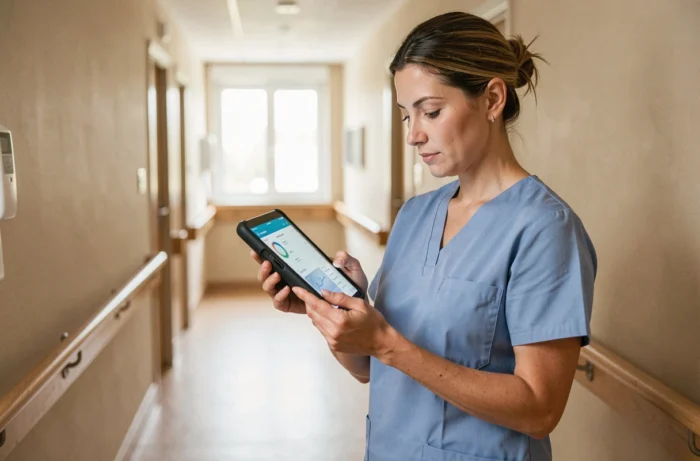
A computerized user file (DUI) refers to the unique digital file that centralizes all medical, paramedical, and administrative information of a resident in a nursing home. Netsoins, published by Orisha and deployed in DomusVi establishments, is one of the most widespread DUI software in the French medico-social sector. Its role goes beyond simple archiving: it structures the circuits of prescription, traceability, and coordination among caregivers on a daily basis.
HDS Reference Version 2 and Data Localization: What Nursing Homes Need to Verify
Most presentations of Netsoins highlight ease of use or telemedicine features. A less visible but directly operational angle concerns the obligations related to health data hosting (HDS).
The HDS reference version 2.0, which came into effect for new audits and renewals, modifies compliance requirements. Health data storage must now be exclusively located within the European Economic Area, with increased transparency obligations regarding remote access from third countries.
For a nursing home using Netsoins, this concretely means that the software’s host must prove this European localization. Furthermore, decree n°2026-209 of March 24, 2026, has included the electronic archiving of health data within the HDS scope. Resident files kept over several years thus fall under this expanded obligation.
Understanding the use of Netsoins DomusVi in nursing homes also involves this regulatory dimension, which conditions the overall compliance of the establishment.
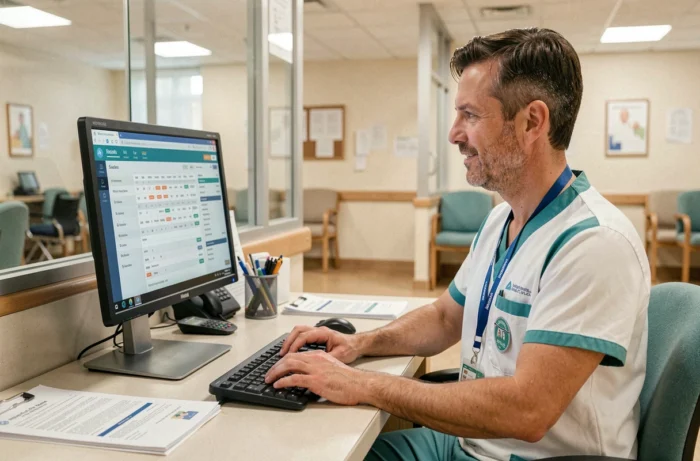
Referenced DUI Ségur du numérique: A Condition for Accessing Funding in Nursing Homes
The digital ESMS program, led by the ARS and supported by national funding, requires medico-social establishments to adopt a referenced DUI Ségur du numérique in health. Without this referencing, a nursing home cannot claim the aids dedicated to digital transition.
Netsoins has this referencing, which partly explains its dissemination in groups like DomusVi. The issue is not only technical: it is a budgetary arbitration. An establishment that chooses non-referenced software would have to finance its entire digital transition from its own funds.
What Ségur Referencing Technically Implies
A referenced DUI must comply with an interoperability framework defined by the Health Digital Agency. This includes the ability to exchange structured health documents with other actors (city doctors, hospitals, pharmacies) via secure health messaging.
- Inputting the resident’s Shared Medical Record (DMP) from the software, without manual re-entry
- Issuing and receiving electronic prescriptions compliant with the national format
- Complete traceability of data exchanges between the nursing home and external healthcare professionals
For caregiving teams, this interoperability reduces double entries and phone calls to retrieve a hospitalization report or a treatment modification.
Traceability of Care in Netsoins: Beyond the Communication Log
Care traceability is the functional core of a DUI in a nursing home. In Netsoins, each action performed on a resident (medication administration, dressing, vital signs monitoring) is time-stamped and linked to the professional who performed it.
This mechanism replaces the paper communication log, but its scope goes further. During an evaluation by the High Authority of Health or an ARS audit, the establishment must be able to produce a reliable history of the care provided. A properly filled DUI constitutes a rebuttable presumption in case of a dispute or a family’s complaint.
Configuration: An Often Underestimated Factor
The quality of traceability directly depends on the initial configuration of the software. A poorly configured Netsoins can generate unnecessary alerts or, conversely, fail to signal a forgotten care. The settings cover several levels:
- Defining care plans by resident profile (GIR, chronic pathologies, specific risks such as falls or pressure ulcers)
- Configuring validation circuits for medication prescriptions, distinguishing between high-risk medications and standard treatments
- Setting up targeted transmissions that filter relevant information for each category of caregiver (nurse, nursing assistant, coordinating physician)
A rigorous configuration takes several weeks during deployment. Establishments that rush this phase end up with an underutilized tool, where teams bypass the software with handwritten notes.
Mobile Access and Real-Time Entry: Impact on Care Workload
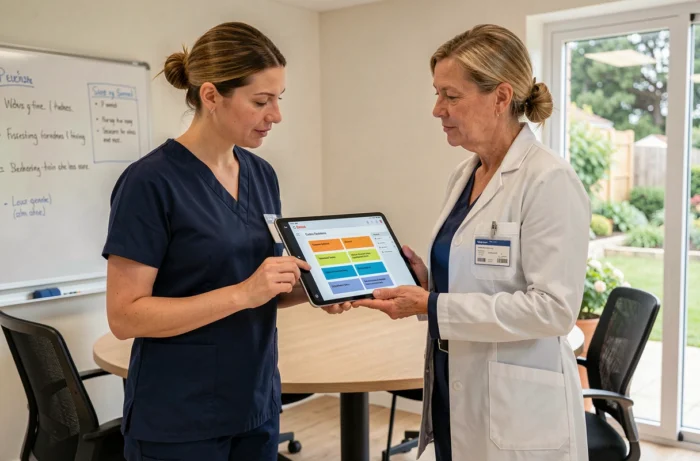
Netsoins operates in web mode, accessible from a tablet or a fixed workstation. Data entry at the resident’s bedside, on a tablet, modifies the workflow of nursing assistants and nurses. Instead of noting information on paper and then transcribing it at the end of the shift, the caregiver records the action at the moment it is performed.
This real-time entry presents a direct advantage for data reliability. A delay of several hours between the action and its entry increases the risk of forgetting or error. It also poses constraints: the establishment’s Wi-Fi network must cover all floors and rooms, which is not always the case in older buildings.
Authentication is another friction point. Each caregiver must log in with their personal credentials to ensure traceability. In practice, shared sessions or generic passwords remain a frequent pitfall, undermining the evidential value of the file.
The deployment of Netsoins in DomusVi nursing homes illustrates an underlying trend: the digitization of care in the medico-social establishment goes beyond simply replacing paper with a screen. It commits the establishment to HDS compliance obligations, Ségur referencing, and rigor in daily configuration. The quality of care recorded in the software primarily depends on team training and the technical infrastructure on which it relies.