
Among the hundreds of tools listed in DIY catalogs, those whose names start with the letter M hold a special place. Hammer, tape measure, grinder, mallet: these tools serve very different functions, from measuring to cutting, striking, and sanding. Comparing their uses, motorization, and lifespan allows for the creation of a coherent toolbox rather than a pile of impulsive purchases.
M Tools for DIY: Comparative Table of Functions and Motorizations
| M Tool | Main Function | Motorization | Compatible Materials | Frequency of Domestic Use |
|---|---|---|---|---|
| Hammer | Striking, driving nails | Manual | Wood, plaster, light metal | Very frequent |
| Mallet | Heavy striking, light demolition | Manual | Stone, concrete, tiles | Occasional |
| Tape Measure | Linear measurement | Manual | All | Very frequent |
| Grinder | Cutting, sanding, deburring | Electric (corded or battery) | Metal, stone, tiles | Frequent |
| Mallet | Striking without marking the surface | Manual | Wood, laminate, joints | Occasional |
| Multimeter | Electrical diagnostics | Battery (cell) | Circuitry, wiring | Occasional |
| Sealant Gun | Sealing, bonding | Manual or battery | Wood, glass, PVC, masonry | Frequent |
This table highlights a first discrepancy: manual M tools remain the majority in this category. Only the grinder and certain versions of the sealant gun fall under the category of power tools. The direct consequence is a moderate entry budget for equipping a home workshop with these references.
Each M tool for DIY corresponds to a specific technical action, and it is this specialization that justifies acquiring them separately rather than relying on a generic kit.
Hammer, Mallet, and Wooden Mallet: Three Striking Tools with Distinct Uses
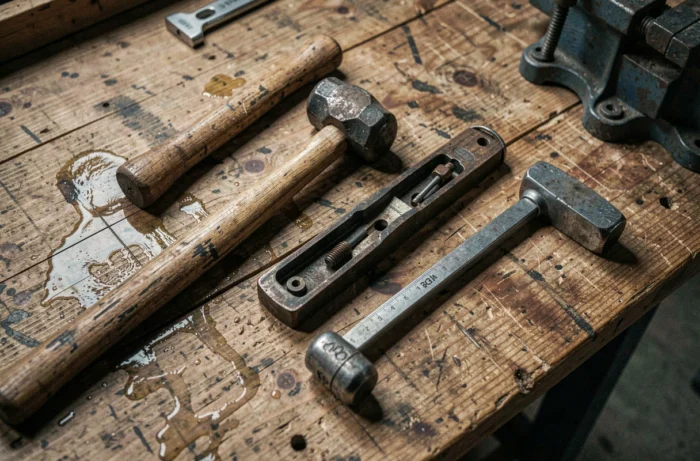
The confusion between these three tools is common. Their weight, the material of their head, and the impact force they transmit make them suitable for very different tasks.
Carpenter’s Hammer and Claw Hammer
The carpenter’s hammer, with its classic-shaped steel head, is used to drive nails into wood or plaster. The claw hammer features a split claw at the back, which eliminates the need for a separate pliers or lever to remove a mis-driven nail. The claw hammer replaces two tools in one.
Mallet for Masonry Work
The mallet weighs significantly more than a standard hammer. It is designed to strike a chisel or brick chisel during light demolition work, tile laying, or plaster removal. Using a standard hammer in its place risks uncontrolled rebound on hard materials like stone or concrete.
Wooden or Rubber Mallet
The mallet protects fragile surfaces (varnished wood, laminate, mortise and tenon joints). Its soft head absorbs the impact instead of concentrating it, preventing marks. For assembling wooden furniture, the mallet is far more suitable than a steel hammer.
Portable Grinder: The Segment Where Semi-Professional Range Prevails
The grinder is the M tool that best illustrates the trend observed by industry players: a growing number of individuals are equipping themselves with semi-professional tools for increased comfort, safety, and durability. The so-called “pro for individuals” ranges represent a compromise between price and performance, according to professionals in the tool market.
However, an entry-level grinder intended for occasional use (cutting a metal tube, deburring a weld) is still sufficient for a casual DIYer. The difference mainly manifests in the lifespan of the motor and the quality of the bearings.
- Angle Grinder (115 or 125 mm disc): the most versatile for home use, suitable for cutting metal, sanding rusty surfaces, and deburring tiles.
- Die Grinder: more compact, useful for finishing in hard-to-reach areas, such as inside a metal cabinet or corner welds.
- Associated Accessories: cutting discs, flap discs for sanding, wire brushes. The choice of disc affects the result as much as the choice of machine.
Wearing protective goggles and appropriate gloves is non-negotiable when using a grinder, regardless of the duration of the task.
Tape Measure and Multimeter: Measure Before Acting
Two M tools pertain to measurement, but in completely different contexts.
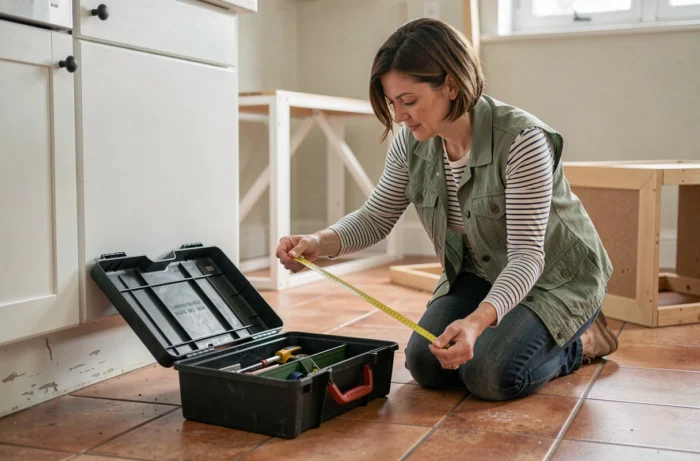
The tape measure is used to take linear measurements before any wood cutting, furniture placement, or shelf installation. A five-meter model covers the majority of domestic needs. Measure twice and cut once remains the most cost-effective rule of DIY.
The multimeter, on the other hand, allows for checking the voltage, continuity, or resistance of an electrical circuit. Before replacing a socket or switch, it identifies whether the current is indeed off and whether the wiring is compliant. Without a multimeter, any intervention on a domestic circuit is done blindly.
Spare Parts and Repair: The Legal Framework Since 2024
One point that classic tool lists do not address: the law n° 2024-364 of April 22, 2024 has amended the Consumer Code to require professionals who market maintenance and repair services for powered DIY tools to offer, for certain categories of parts, spare parts from the circular economy (refurbished, reused) as an alternative to new parts.
For a grinder or electric sealant gun, this means that when having the tool repaired, the repairer must offer the choice between a new part and a reused part. This obligation changes the profitability calculation: extending the life of a semi-professional tool becomes financially more accessible than before.
Building your collection of M tools does not require a considerable budget, provided you distinguish between manual references (hammer, mallet, tape measure) and power tool references (grinder) that deserve an investment in a durable range. The recent legal framework on circular spare parts reinforces this logic: buying a quality tool and having it repaired now costs less than replacing it every two years.