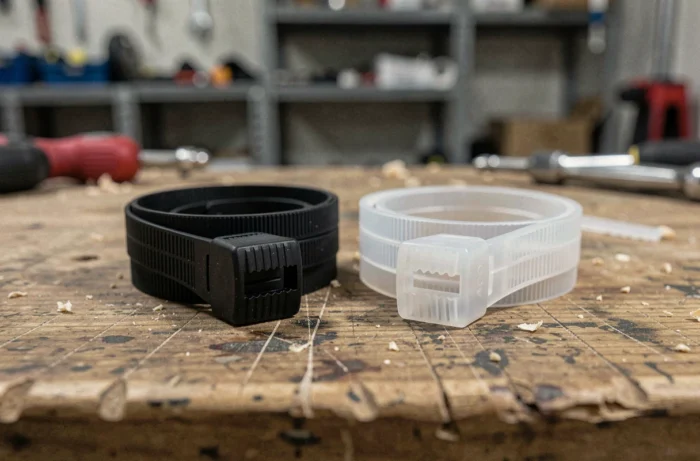
On a construction site, when you open a box of zip ties, no one wonders if it’s “rilsan” or “colson.” You grab the tie, tighten it, and cut it.
The distinction between these two terms only becomes a real issue when you need to choose a product suitable for a specific constraint: temperature resistance, chemical compatibility, regulatory compliance for electrical installations. And there, the confusion in terminology can lead to a poor purchase.
Polyamide 11 vs polyamide 6.6: the real choice criterion for tightening
The term “rilsan” originally refers to a material, polyamide 11 (PA 11), developed by the French company Organico from castor oil. It is a bio-based polymer, used well beyond electrical tightening: automotive parts, offshore pipe coatings, technical nets.
The term “colson,” on the other hand, is a trademark of Legrand. Colson ties are made of polyamide 6.6 (PA 6.6), a petrochemical-based plastic. This is the material found in the vast majority of zip ties sold in electrical supplies.
In daily practice, when an electrician asks for “a rilsan,” they almost always receive a PA 6.6 tie, not a PA 11. Understanding the differences between rilsan and colson helps avoid confusing the name of the material with the name of the brand, and especially to select the right product according to the installation environment.
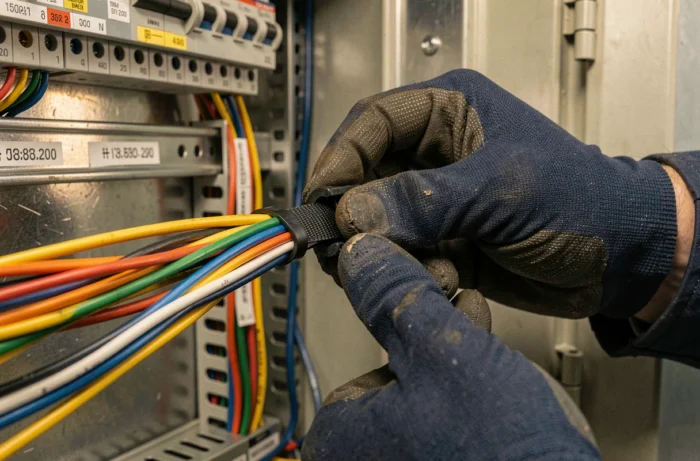
Temperature resistance and chemical resistance: where the material makes all the difference
It is in the field, facing difficult conditions, that the distinction between PA 11 and PA 6.6 makes sense. The two polyamides do not react the same way.
Thermal behavior
PA 6.6 (Colson type) withstands a wide temperature range, suitable for most common indoor and outdoor installations. PA 11 retains its flexibility at lower temperatures, making it relevant in cold environments or subjected to marked thermal cycles.
In a boiler room, in a technical false ceiling above halogen lighting, or outdoors exposed to frost, the choice of polyamide is not trivial. A standard PA 6.6 tie can become brittle after several seasons of freeze-thaw cycles if the quality is not up to par.
Resistance to chemical agents
PA 6.6 performs well against oils, greases, and most common solvents. PA 11 offers better resistance to hydrolysis (degradation by water over the long term), which explains its use in sectors like offshore or underground networks.
For a typical domestic or tertiary electrical installation, PA 6.6 covers almost all needs. PA 11 is reserved for cases where permanent humidity or chemical exposure is out of the ordinary.
IEC 62275 standard and electrical tightening: what has changed for ties
The zip ties used as cable supports in electrical installations are now covered by the international standard IEC/UL 62275. This standard specifies mechanical tests, fire resistance, and the conditions of use for plastic cable management systems.
In practical terms, a tie sold for decorative tightening or packaging does not meet the same requirements as a tie intended to hold cables on a cable tray in a technical room. Only ties explicitly qualified according to this standard guarantee compliance of an installation with the requirements of NF C 15-100 regarding cable routing and support.
This point is often overlooked. One buys a bag of ties at a DIY store to wire a panel without checking the regulatory mention on the packaging. In total renovations or new housing, the reinforced requirements of NF C 15-100 on cable routing impose compliant ties, whether they are made of PA 6.6 or PA 11.
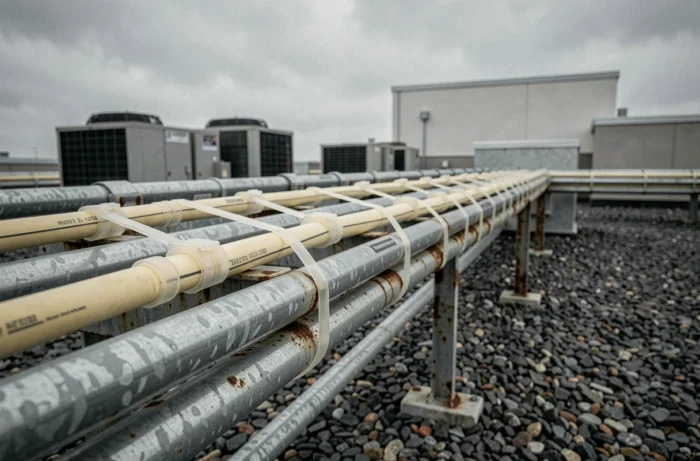
Selection criteria for a zip tie for an electrical installation
Rather than choosing between “rilsan” and “colson” out of habit, it is more efficient to reason by constraints. Here are the parameters that guide the choice on the ground:
- Width and length of the tie: a thick bundle of cables requires a wider tie to distribute pressure without risking cutting the sheath. The tie is sized to the diameter of the bundle, not the other way around.
- Installation environment: dry indoor (standard PA 6.6 is sufficient), outdoor exposed to UV (black UV-stabilized tie is mandatory), permanently humid or chemical environment (PA 11 or stainless steel depending on the case).
- Function of the tie: simple bundling of cables, fixing to a support (base tie), circuit identification (colored ties). Each use has a suitable product.
- Regulatory compliance: for any installation subject to NF C 15-100, check the IEC 62275 qualification of the product.
Feedback varies on the durability of low-cost ties against UV. In outdoor installations, some electricians report visible degradation after two or three years, whereas a black UV-stabilized branded tie lasts significantly longer.
Reusable tie or standard tie: a choice often overlooked
A final point rarely addressed: ties with repeated opening. Classic models are self-locking and single-use. Once tightened, the excess is cut off, and that’s it. To modify the bundle, you have to cut the tie and put on a new one.
There are ties with a release tab, reusable, practical during prototyping or commissioning when the cables are still moving. These models are more expensive per unit, but they are increasingly found in boxes and electrical cabinets where intervention is anticipated.
- Standard self-locking tie: permanent use, low cost, ideal for completed installations.
- Reusable tie (with tab): suitable for evolving cabinets, prototypes, environments requiring frequent interventions.
- Base tie: fixed to a support by screw or adhesive, used to guide cable routing along a wall.
The term “rilsan” or “colson” says nothing about these functionalities. What matters is the material, the width, the standard, and the type of locking. A well-chosen tie protects the installation as much as the cable it holds.