
Some people feel a marked attraction to statues of saints, virgins, or angels. This is not just a simple taste for sacred art or religious devotion. Hagietomamophilia specifically refers to this fascination, sometimes intense, for sculpted representations of the sacred. The term remains little known, even in specialized circles of psychology or art history.
Etymology and definition of hagietomamophilia
The word breaks down into three Greek roots: hagios (holy, sacred), agalma (statue, sculpted image), and philia (attraction, love). Together, they describe a fascination centered on religious statues. The nuance is important: we are not talking about an interest in any sculpture, but specifically in those that represent sacred figures.
Have you ever felt a particular emotion in front of a polychrome Virgin in a countryside chapel, or in front of a baroque angel with delicate features? This reaction, when it goes beyond simple aesthetic admiration to become a recurring and deep attraction, falls within the realm of hagietomamophilia.
The concept is close to agalmatophilia, which refers to attraction to statues in general. Hagietomamophilia is a more restricted variant, limited to the sacred register. To learn more about hagietomamophilia on Sciences, Philo, Etc …, the intersection of spiritual and aesthetic dimensions forms the core of this fascination.
Religious statues and emotional charge: why the sacred amplifies attraction
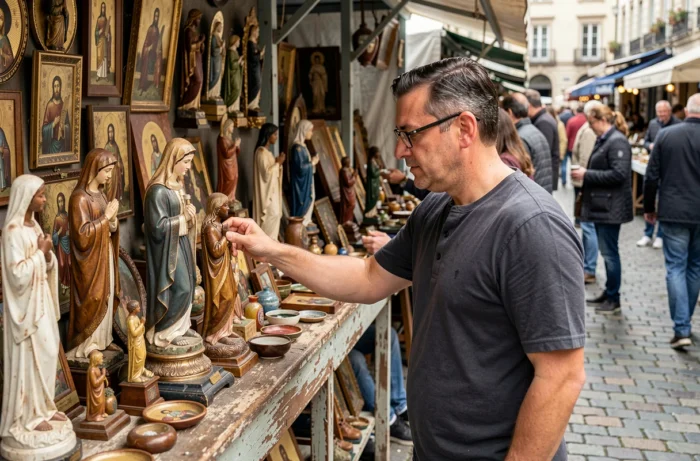
A statue in a contemporary art museum and a processional Virgin in an Andalusian church do not produce the same effect. The sacred context adds an emotional layer that intensifies the relationship with the object. Incense, dim light, candles, and liturgical music contribute to creating a highly charged sensory environment.
Religious statues also have material particularities that distinguish them. In Catholicism, the tradition of dressing statues in fabric garments dates back to the late Middle Ages. This practice, documented by art historians, blurs the boundary between the sculpted object and the human body. A Virgin dressed in a real silk gown, adorned with real hair and jewelry, is no longer quite an inert object.
This phenomenon of symbolic animation plays a direct role in hagietomamophilia. The fascinated person does not look at a frozen sculpture but perceives a presence. Dressing the statues reduces the distance between stone and the living.
The role of the Pygmalion myth
Since antiquity, Western culture has maintained the idea that a statue can come to life. The myth of Pygmalion, a sculptor who fell in love with his own creation, has traversed the centuries. It feeds an imagination where the boundary between the work of art and the animated being remains porous.
Applied to the religious register, this myth takes on an additional dimension. Statues of saints are supposed to embody a divine presence. Stories of miraculous statues (that weep, bleed, or move) have existed in Catholic tradition for centuries. The sacred transforms the statue into a potential receptacle of supernatural life.
Psychiatric classification: is hagietomamophilia a mental disorder?
The short answer: no, not as such. Recent psychiatric classifications, notably the DSM-5-TR and the ICD-11 (both published in 2022), do not recognize agalmatophilia as a distinct diagnosis. Hagietomamophilia, an even more specific variant, is not listed either.
What has changed in contemporary psychiatric approaches is the central evaluation criterion. The type of object (statue, image, idol) is no longer decisive. What matters are three elements:
- The presence or absence of personal suffering related to this attraction
- The impact on daily functioning (social, professional, relational life)
- The existence or not of harm caused to others
A person fascinated by religious statues without suffering from it and without harming anyone does not fall under any psychiatric diagnosis. The interest is considered atypical, not pathological.
Hagietomamophilia and collectors of sacred art: where does fascination begin?
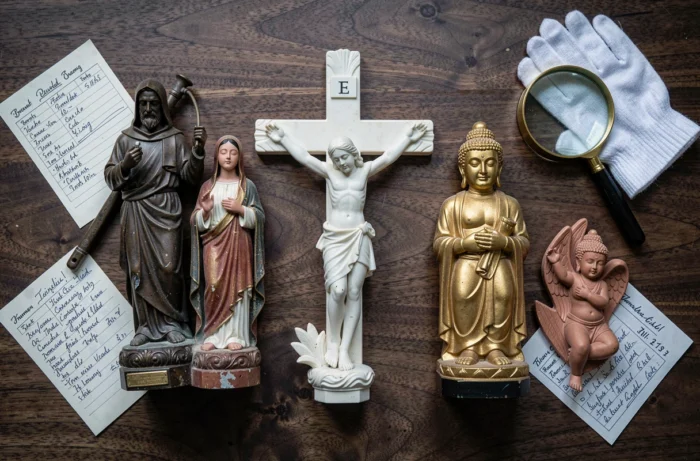
The boundary between passionate collecting and hagietomamophilia remains blurry. Many collectors of sacred art maintain a very personal relationship with their pieces. They restore wooden virgins, search for 15th-century limestone saints, and create dedicated spaces in their homes.
Some clues help distinguish the two:
- The collector is interested in the provenance, technique, and market value of the piece
- The person concerned by hagietomamophilia describes an emotional or physical relationship with the object, independent of its historical value
- The spiritual or mystical dimension of the statue matters more than its objective artistic qualities
Hagietomamophilia is characterized by an emotional bond with the statue itself, not with what it represents in the art market. The relationship is intimate, often difficult to articulate for the person experiencing it.
A discreet but documented phenomenon
Testimonies remain rare in the public space. The religious dimension adds an additional layer of taboo compared to classic agalmatophilia. Defiling a museum statue and defiling a saint statue do not carry the same symbolic weight.
This discretion partly explains why the term hagietomamophilia circulates little. The people concerned do not use this word to describe themselves. They speak of fascination, attraction, sometimes devotion, without always identifying that their relationship with sacred statues falls under a named and documented phenomenon.
Hagietomamophilia remains a territory where art history, religious anthropology, and psychology intersect. Understanding this fascination requires accepting that the sacred and the aesthetic produce effects that go beyond simple contemplation. The gaze directed at a statue of a saint is anything but neutral, and it is precisely this absence of neutrality that defines the phenomenon.