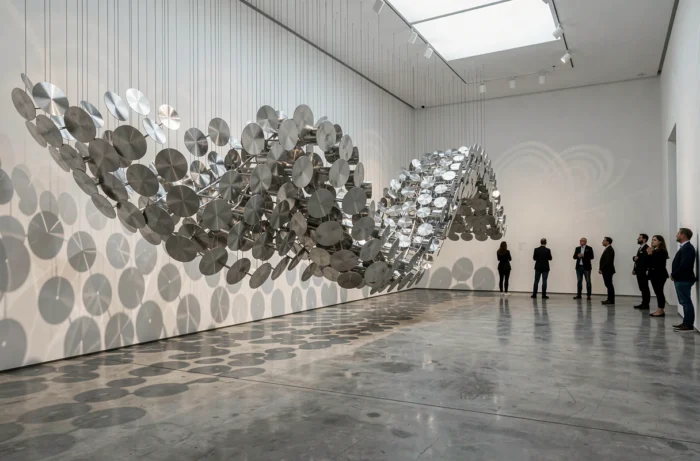
Optical art and kinetic art share a common ground: that of visual perception as a material for creation. Their point of junction lies in the ability of a surface or object to produce a sensation of movement, whether that movement is real or strictly illusory. This artistic field, structured since the 1950s-1960s, continues to raise questions about how the brain interprets what the eye receives.
Perceptual variability: why an illusion of movement does not work for everyone
A persistent assumption is that moving optical illusions produce the same effect in every observer. Recent work in neuroscience contradicts this idea. An illusion based on focusing on a black dot at the center of a tunnel pattern, intended to provoke a sensation of advancing into darkness, is not perceived by about 20% of the tested subjects.
For those who perceive the illusory movement, the reaction goes beyond the visual: researchers have measured an automatic dilation of the pupils, as if the visual system actually anticipates an entry into a dark space. This involuntary physiological mechanism shows that the illusion is not limited to a “graphic trick,” but engages deep neurological circuits.
Researchers emphasize that they currently have no robust explanation for this resistance in the minority impervious to the effect. This data calls into question the supposed universality of certain kinetic works: in an exhibition, moving optical illusions do not produce an identical experience for every spectator, which changes the way their artistic effectiveness is evaluated.
Op art and kinetic art: a technical boundary often misunderstood
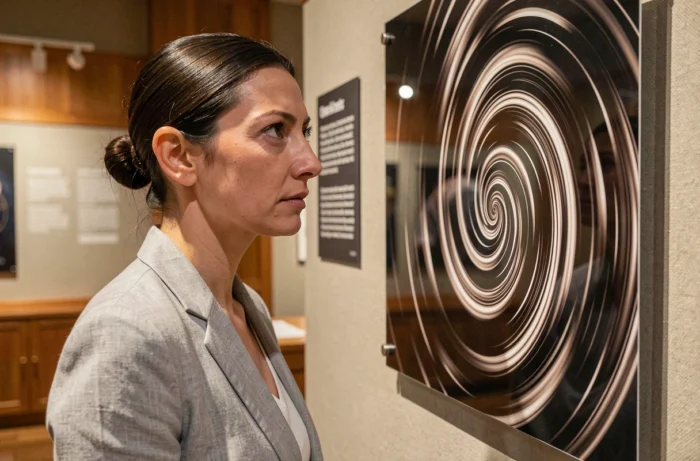
Op art (optical art) and kinetic art are frequently confused or treated as synonyms. However, the distinction is structuring. Op art produces strictly virtual movement effects, inscribed on a fixed surface. Lines, patterns, chromatic contrasts, and geometric repetitions exploit the limits of the human visual system to create vibration, undulation, or depth where there is none.
Kinetic art, on the other hand, incorporates real movement. The work moves, whether through a motorized mechanism, the displacement of air, or the physical intervention of the spectator. Julio Le Parc, a central figure in kineticism, worked with reflected light on movable metallic surfaces. The movement is not simulated by the eye: it exists in space.
When the boundary fades
Some works occupy a gray area. Does a stationary sculpture whose surface produces a moiré effect depending on the viewer’s angle belong to Op art or kineticism? The movement of the spectator becomes the very engine of the perceived movement. Julio Le Parc specifically explored this ambiguity, creating pieces where the visitor’s participation activates the visual effect without any motor being necessary.
This intermediate zone explains why the two terms remain intertwined in everyday language, even though their technical foundations diverge.
Illusions of movement and pseudo-science: what online tests do not measure
Many popular contents use illusions of movement to claim to reveal whether a person is “more logical or more creative.” Neuroscientists have clarified this point: these tests have no scientific validity.
The perception of an illusion depends on physiological factors (visual acuity, eye fatigue, contrast sensitivity) and not on a “type of thinking.” Attributing a psychological meaning to how someone perceives a spiral pattern or a grid of moving dots is misinformation.
- Pupil dilation in response to a tunnel illusion is a physiological reflex, not an indicator of personality
- Resistance to certain illusions concerns about one-fifth of the population, with no known correlation to intelligence or creativity
- The mechanisms of perception of illusory movement involve brain areas related to low-level visual processing, not higher cognitive functions
This confusion between art, perception, and popular psychology hinders the real understanding of the mechanisms at play in optical art.

Immersive kinetic installations: space as a component of the work
The recent evolution of kinetic art pushes the logic of perceived movement towards immersive formats. Contemporary installations no longer settle for an isolated painting or sculpture: they transform the entire space into a perceptual device.
Light, sound, and projections are added to traditional optical processes. The spectator no longer looks at the work; they move inside it. This shift alters the very nature of the illusion: the whole body participates in constructing the effect, not just the eye.
Limits of the immersive format
Field feedback diverges on this point. Some artists and critics believe that the immersive format dilutes the perceptual rigor of classic Op art in favor of the spectacular. Others see it as a logical extension of the kinetic project as formulated by Le Parc or Vasarely: making art accessible and physically engaging.
Victor Vasarely, from the design of his Foundation in Aix-en-Provence, integrated architecture as a support for the optical effect. The “architectural integrations” he installed there transform the walls into active surfaces. The building itself becomes a monumental-scale kinetic work.
- Contemporary immersive installations extend this logic by adding digital technologies (sensors, real-time projections)
- The physical interaction of the visitor with the space replaces the frontal contemplation inherited from easel painting
- The question of reproducibility arises: does an installation calibrated for a specific location lose its effect in another spatial context?
Kinetic art and Op art continue to function as a laboratory of perception. Their interest goes beyond simple visual fascination: they question what the brain produces from incomplete signals, and remind us that seeing is never a neutral act.