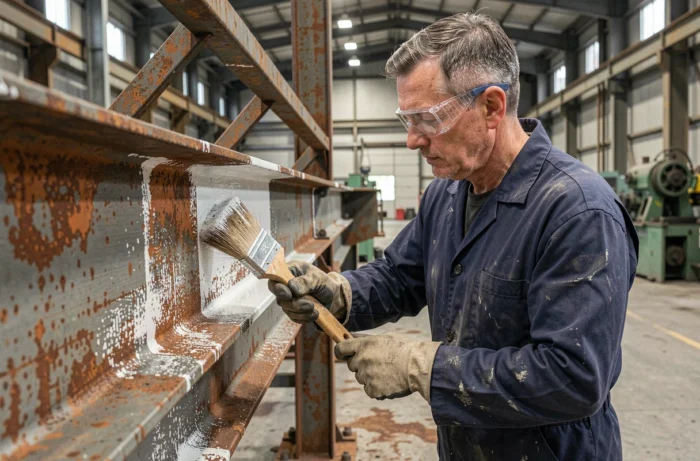
On a buried pipeline for fifteen years, a simple corrosion pit of a few millimeters is enough to cause a leak. On a metal framework exposed to sea spray, the loss of thickness can sometimes reach several tenths of a millimeter per year. The fight against corrosion is not an aesthetic choice: it is a technical constraint that determines the lifespan of any structure made of steel, iron, or alloy.
Corrosion accounts for about 3.5% of the global GDP each year, which translates to 84 billion euros lost annually just in France.
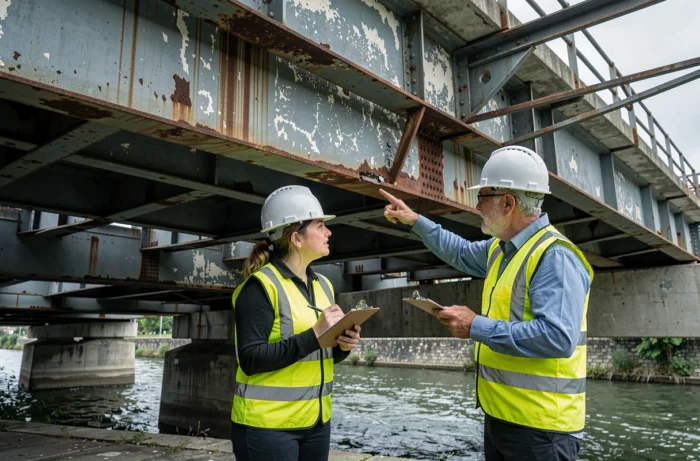
Site Diagnosis Before Anticorrosion Work: What Changes Everything
A carbon steel tank exposed to brackish water is not treated the same way as an industrial building beam subjected to condensation. The preliminary diagnosis determines the method, cost, and durability of the protection.
Before choosing a coating or cathodic system, three concrete parameters are evaluated: the nature of the metal (carbon steel, stainless steel, zinc, aluminum), the type of environment (atmospheric, submerged, buried, chemical), and the degree of existing degradation. An ultrasonic thickness measurement allows for assessing material loss and deciding between local repair and replacement.
This diagnostic step is often overlooked in maintenance quotes. You can regularly find corrosion work on Happy Space that documents this type of intervention, from surface preparation to the application of the protection system.
Without precise diagnosis, anticorrosion treatment is a gamble. Applying epoxy paint on poorly stripped steel or choosing an unsuitable coating for the environment amounts to wasting time and budget.
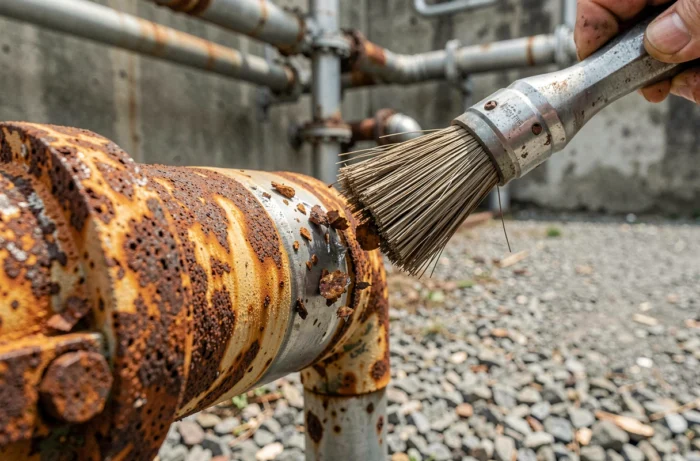
Surface Preparation: The Step That Makes a Difference in Anticorrosion Protection
You can invest in the best coating on the market, but it won’t adhere to a poorly prepared surface. In practice, preparation accounts for the majority of the time spent on site for corrosion control work.
Shot Blasting and Mechanical Stripping
Shot blasting projects microbeads of steel or corundum onto the metal piece to remove rust, scale, and old coatings. This creates a rough anchor profile that allows the new system to mechanically bond.
For large structures (bridges, tanks, pylons), turbine shot blasters are used. For smaller pieces or hard-to-access areas, hand sanding remains the norm. The desired cleanliness level (Sa 2½ according to ISO 8501-1) directly affects the adhesion of the coating.
Degreasing and Chemical Treatment
Greases, oils, and organic contaminants prevent any adhesion. Solvent or alkaline degreasing systematically precedes mechanical stripping. In some cases, a complementary chemical treatment (phosphating, chromating) creates a conversion layer that improves adhesion and corrosion resistance of the material.
- Alkaline or solvent degreasing to eliminate greasy substances before any mechanical abrasion
- Shot blasting or sanding to reach white metal and create an anchor profile suitable for the intended coating
- Careful dust removal, as trapped shot residues under the paint become corrosion initiation points
- Control of the soluble salt content on the surface (chlorides, sulfates), a factor in premature coating delamination
Anticorrosion Protection Systems: Choosing Based on the Environment
The choice of protection system directly depends on the exposure environment and the expected lifespan. Three main families are distinguished, often combined on the same structure.
Organic Coatings: Paints and Resins
Multilayer systems (zinc-rich primer, epoxy intermediate layer, polyurethane finish) remain the most common solution in atmospheric and industrial environments. A well-applied three-layer system protects a metal structure for fifteen to twenty-five years depending on the aggressiveness of the environment.
European regulations are pushing towards formulations with high solid content or water-based, reducing emissions of volatile organic compounds. Powder coatings, applied by electrostatic spraying and baked in an oven, are gaining ground on compatible-sized parts.
Metallization and Galvanization
Hot-dip galvanization involves immersing the steel piece in a bath of molten zinc. The resulting layer protects by barrier effect and cathodic protection: the zinc corrodes preferentially, sacrificing its material to preserve the underlying steel.
Thermal spray metallization (zinc, aluminum, or zinc-aluminum alloy) allows for treating pieces that are too large for a galvanization bath. The molten metal is sprayed onto the prepared surface, creating a porous layer that is then sealed with a varnish or paint.
Cathodic Protection for Buried or Submerged Structures
Cathodic protection imposes an electric current that prevents metal dissolution. Two variants exist: sacrificial anodes (blocks of zinc or magnesium attached to the structure) and current withdrawal imposed by an external rectifier.
This principle is found on pipelines, ship hulls, buried tanks, and reinforced concrete reinforcements exposed to chlorides. The lifespan of sacrificial anodes varies according to soil resistivity, but regular monitoring of the structure’s potential allows for anticipating replacements.
Anticorrosion Work and Energy Transition: A Strongly Increasing Demand
Renewable energy infrastructures generate anticorrosion protection needs that traditional sectors (petrochemicals, construction) had not anticipated at this scale. Offshore wind, hydrogen, and geothermal energy expose metallic materials to particularly aggressive environments: seawater, acidic soils, atmospheres laden with hydrogen sulfide.
The monopile foundations of offshore wind turbines, for example, combine galvanization, epoxy coating, and cathodic protection with sacrificial anodes. This type of multilayer system requires precise coordination among trades and rigorous quality control at every stage.
- Offshore wind: cathodic protection combined with high-performance coatings on submerged structures in saltwater
- Hydrogen: risk of hydrogen embrittlement of high-strength steels, requiring specific alloys and coatings
- Geothermal: geothermal fluids loaded with salts and corrosive gases, requiring resistant materials like duplex stainless steels
The fight against corrosion on these new structures mobilizes cross-disciplinary skills: materials engineering, electrochemistry, civil engineering. Water-based and powder coating segments are experiencing annual growth significantly higher than solvent-based formulations, driven by European regulatory constraints on volatile organic compound emissions.
Each anticorrosion protection project relies on a precise sequence: diagnosis of the material and its environment, appropriate surface preparation, choice of system based on the target lifespan, and then monitoring during operation. Skipping a step reduces the lifespan of the structure and multiplies the costs of repairs.