
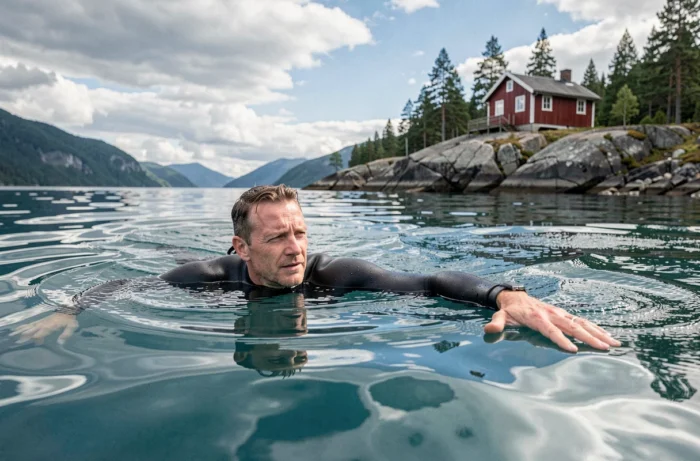
The water in the Norwegian fjords rarely exceeds fifteen degrees in the height of summer. This temperature, combined with considerable depths and sometimes dense maritime traffic, requires treating each swim as a technical activity, not just a simple vacation dip. Understanding the mechanisms of cold, identifying suitable areas, and knowing local warning signals makes the difference between a memorable experience and an avoidable accident.
Cold Water Shock: The Mechanism to Know Before Entering a Fjord
The cold water response refers to the involuntary reaction of the body upon contact with water significantly colder than skin temperature. The first few seconds provoke a brutal reflex inhalation, an acceleration of heart rate, and a rise in blood pressure. This reflex, sometimes called the “gasping reflex,” can lead to water inhalation if the head is submerged at that moment.
The solution lies in a gradual entry. Wetting the neck, wrists, and chest before immersing helps mitigate the shock. Staying close to the shore for the first two minutes allows the body time to adapt.
After a few minutes, another phenomenon takes over: loss of motor skills. The muscles in the hands and forearms cool down, and the ability to swim or grip decreases. Setting a maximum short swimming duration and adhering to it remains the best strategy for those who wish to swim in the fjords of Norway without underestimating the environment.
Beach Monitoring and Water Quality: Disparities Among the Fjords
Not all swimming areas in fjords have the same level of supervision. In Oslo, the beaches of Huk and Sørenga have lifeguards from June to August. Outside this period, or at other spots in the same fjord, no supervision is provided.
This observation holds true for the vast majority of the fjords in the country. Outside of developed urban beaches, swimming is done without a safety net. No one reports a struggling swimmer, and the rocky shores make exiting the water more challenging than a sandy beach.
Water Quality Alerts After Heavy Rain
The municipality of Oslo publishes updates when the water quality falls below acceptable thresholds. These episodes mainly occur after heavy rainfall, when urban runoff carries bacteria into the fjord. This phenomenon is rare, but checking local bulletins before entering the water can prevent an unpleasant surprise.
In Horten, the municipality explicitly includes the presence of algae and cyanobacteria in its recommendations. When concentrations are high, the message is clear: do not swim and especially do not ingest water. This type of alert exists in several coastal Norwegian municipalities, and the information signs on-site are worth reading, even if their content is in Norwegian.
Maritime Traffic in the Fjords: A Hidden Danger from the Water
A fjord is not an isolated lake. Ferries, cruise ships, rental kayaks, and fishing boats share the same waters. In the outer sector of the Oslo fjord, for example, the traffic from island ferries creates areas where the visibility of a swimmer from a ship’s deck is nearly zero.
The problem is not limited to large vessels. The wake waves generated by motorboats reach the shore with a delay of several seconds. A swimmer close to the edge may be overwhelmed by a wave they did not see coming.
Three precautions significantly reduce this risk:
- Choose coves or bays away from marked shipping routes, rather than areas near ferry docks.
- Wear a brightly colored swim cap, or better yet, a buoy for open water swimming, to remain visible from boats.
- Never swim alone: a person remaining on shore can signal danger or alert rescuers.
Equipment and Physical Preparation for Cold Water Swimming
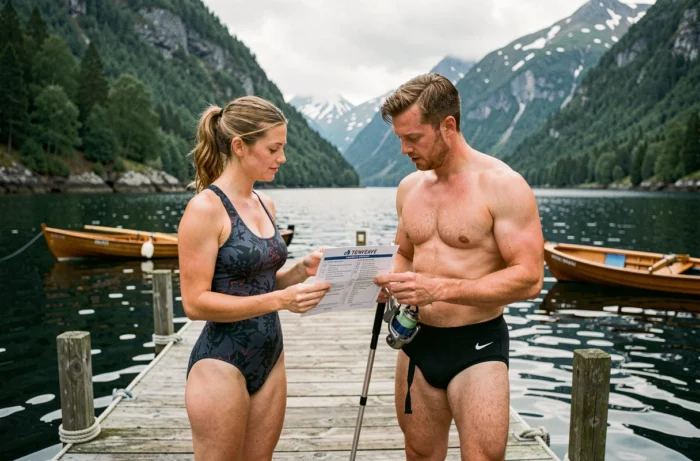
The wetsuit is not just for divers. In the fjord, a three-millimeter thick wetsuit extends swimming duration and reduces the intensity of the initial thermal shock. For a few minutes of immersion without a wetsuit, neoprene booties at least protect the feet from sharp rocks and the cold that rises from the extremities.
What to Bring to the Fjord
- A thick towel or changing poncho to warm up quickly after exiting the water.
- A hot drink in a thermos: post-swim warming also comes from within.
- A phone in a waterproof pouch, left on the shore with the person who is monitoring.
- Warm, dry clothes to put on immediately, including a hat if the wind is blowing.
Physical preparation also plays a role. Swimmers accustomed to cold water gradually develop a tolerance to thermal shock. For a first swim in a fjord, limiting immersion to a few minutes and observing one’s own reaction before considering longer sessions remains the most reasonable approach.
Periods and Fjords Suitable for Swimming in Norway
The most comfortable swimming window is between late June and mid-August. The water reaches its warmest temperatures then, and the length of the day facilitates logistics. The southwest fjords, like the Hardangerfjord, enjoy a slightly milder climate than those in the north.
Narrow and shallow fjords warm up more than large open sea arms. Conversely, a fjord like the Sognefjord, with its extreme depths, retains icy water even at the surface in warm weather.
Checking the local weather on the same day is a non-negotiable step. A clear sky in the morning can give way to cold winds and showers within hours. Conditions in the fjord change quickly, and the combination of wind and cold water dangerously accelerates heat loss.
Swimming in a fjord remains an accessible activity as long as the cold is treated as a technical parameter, not just a simple inconvenience. Each outing requires preparation: scouting the spot, checking local alerts, having the right equipment, and having a companion present. This minimal framework transforms a real risk into a controlled experience.