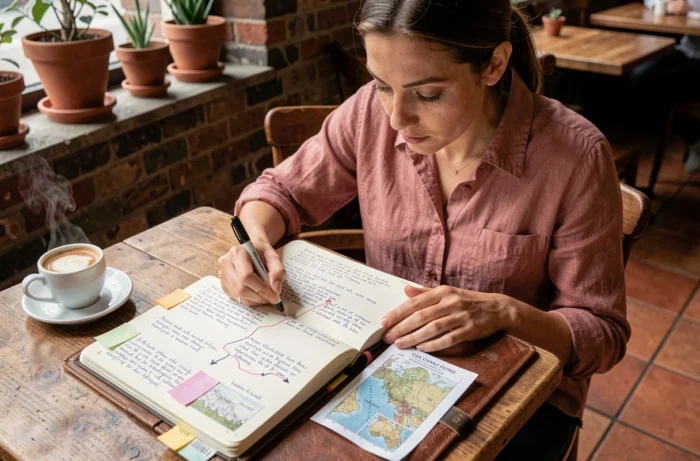
Creating a personalized travel itinerary is not just about stacking destinations on a map. The difference between a memorable stay and a generic route often lies in the method used to assemble the steps, manage logistical constraints, and adjust the pace throughout the journey. Several recent tools are changing the way we build a trip by integrating parameters that traditional guides overlook.
Static or dynamic planning: what travel tools really change
Most articles on itinerary creation describe a linear process: choose a destination, list the places, book. This approach assumes that the traveler has all the information from the start. Recent planners work differently.
Platforms like Polarsteps, itimaker, or One Way Guide allow you to reorganize the steps in real-time, with immediate updates to the map and travel times. Moving a visit from Tuesday to Thursday automatically recalculates distances and the feasibility of the day.
| Approach | Static method (spreadsheet, notebook) | Dynamic method (interactive planner) |
|---|---|---|
| Reorganization of steps | Manual, without recalculation | Drag-and-drop with map and route updates |
| Travel time | Estimated manually or not considered | Automatically calculated between each step |
| Grouping by proximity | To be checked manually | Geographical grouping suggestions |
| Budget | Separate spreadsheet | Integrated into the itinerary, updated in real-time |
| Sharing with companions | File sending | Online collaboration, synchronized changes |
This table summarizes the gap between two ways of building an itinerary. Dynamic planning does not render the static method obsolete, but it reduces the risk of creating a logistically unrealistic route.
For travelers who prefer to delegate this step, designing a custom itinerary with Voyage sur Mesure allows them to rely on specialists who integrate these constraints from the outset of the journey design.

Geographical proximity and travel time: the filter most travelers overlook
A travel itinerary rarely fails due to a lack of ideas. It fails because the steps are too far apart, making the days become transport marathons, or because the traveler arrives exhausted at each new point of interest.
Recent itinerary generators emphasize logistical realism by grouping visits by proximity. Rather than placing locations in the order they come to mind, these tools organize the days around coherent geographical areas, taking into account plausible travel times between each stop.
This logic changes the structure of a trip. Instead of crossing a city three times in the same week to visit nearby sites scheduled on different days, the route concentrates activities in the same neighborhood or area on a single day.
Applying this principle without a dedicated tool
- Place all points of interest on a map (Google Maps is sufficient) and visually identify geographical clusters before defining the order of the days
- Estimate a realistic travel time between each step, adding a margin for unforeseen events (transport delays, queues, breaks)
- Limit the number of areas visited per day: two to three areas maximum avoid exhaustion and leave time for improvisation
- Check opening hours and closing days before finalizing the order of visits, as a museum closed on Monday can disrupt the entire grouping logic
Advanced customization: beyond the destination and budget
Customizing a travel itinerary goes far beyond choosing a destination and a financial envelope. Recent tools incorporate parameters that traditional methods ignore.
Some planners take into account past trips to avoid suggesting experiences already encountered. Others allow for indicating negative preferences: types of places to avoid, desired pace (intensive or contemplative), specific dietary needs, or even places saved on social media that one wishes to include in the itinerary.
This granularity changes the nature of the result. An itinerary built on the basis of “destination + budget” produces a generic route. An itinerary that incorporates the traveler’s pace, personal constraints, and past experiences produces a trip that reflects them.

Convergence between planning and booking
A recent trend blurs the line between building an itinerary and making it a reality. Several platforms no longer just offer a route: they allow you to book accommodations and activities directly from the itinerary, without switching to another site. This integration reduces the risk of discrepancies between what is planned and what is actually available on the chosen dates.
However, this convergence raises a question of neutrality. A tool that generates an itinerary and also sells associated services may steer its suggestions toward the best-referenced commercial partners rather than the options most suited to the traveler’s profile.
Travel itinerary: what distinguishes a successful route from a sequence of visits
A personalized itinerary is not measured by the number of places visited. It is measured by the balance between discovery and free time, between planned steps and margins for improvisation.
The most common pitfall is to overload each day for fear of missing something. Planners that automatically calculate travel times help identify this problem before departure. If a day shows six hours of travel for three visits, the signal is clear: it needs to be lightened.
The other often underestimated factor is cumulative fatigue. An itinerary may seem reasonable day by day, but become exhausting over an entire week. Planning at least half a day free every three days allows for absorbing unforeseen events and keeping energy for the highlights of the trip.
Creating a personalized travel itinerary relies less on inspiration than on method. Tools have evolved, logistical constraints are calculated automatically, and customization now goes well beyond choosing a destination. The most reliable filter remains the actual travel time between each step: it is what transforms a wish list into a feasible route.