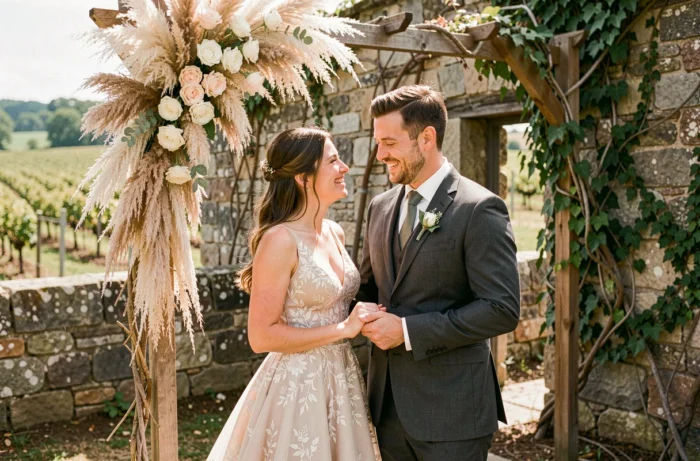
Organizing a personalized wedding involves allocating a budget across items whose relative weight varies significantly. The ideal budget envisioned by French couples now exceeds 30,000 euros, with a clear trend towards reducing the number of guests to finance a more immersive experience. Understanding where the money actually goes, and which trade-offs create a noticeable difference on the big day, helps avoid low emotional return expenses.
Wedding budget distribution: the truly impactful items
Most guides list expenses without prioritizing their impact on the experience of the guests. The table below compares the average budget weight of each item with the level of perception it generates during the day.
| Item | Estimated budget share | Perceived impact by guests |
|---|---|---|
| Venue | About 30 to 40 % | Very high (setting, photos, atmosphere) |
| Catering and drinks | About 25 to 35 % | Very high (taste memory, conviviality) |
| Photographer / videographer | About 8 to 12 % | Low at the moment, very high afterwards |
| Floral decoration | About 5 to 10 % | Medium (perceived overall, rarely in detail) |
| Wedding dress and suits | About 5 to 8 % | High for the ceremony, lower in the evening |
| Entertainment / DJ / band | About 5 to 8 % | Very high (rhythm of the evening) |
| Stationery and invitations | About 2 to 4 % | Low (viewed then stored) |
What stands out: venue and catering capture more than half of the budget and produce most of the memories. In contrast, floral decoration, often overvalued in online inspirations, generates an overall visual impact that few guests detail individually.
Couples who intentionally reduce their guest list to focus the budget on a high-end venue (hotel, exceptional property) follow a measurable logic: the cost per guest increases, but the perceived quality of each element progresses proportionally.

Wedding vendors: balancing between content creators and traditional photographers
A recent phenomenon is redistributing budget lines: about one third of engaged couples seek a dedicated wedding content creator, in addition to or instead of a traditional photographer. Stories, reels, behind-the-scenes filmed in real-time: vertical capture is becoming a criterion for choosing the venue and lighting.
Specialized resources like et-ils-se-marierent.com allow comparisons between vendors and help identify those that match a specific coverage style.
The choice between a solo photographer, a solo videographer, or a versatile content creator depends on the intended use of the images after the wedding. A photographer produces prints and an album. A content creator produces short formats that can be immediately used on social media. The two do not meet the same need, and combining them represents a significant additional cost that must be anticipated from the budget construction stage.
Eco-friendly wedding decoration: rental vs. purchase
Recent trends push towards decoration centered on rental rather than purchase. The concept of a “wedding closet” (shared wedding wardrobe) now extends to dishes, furniture, and scenographic elements.
- Renting vintage or mismatched tableware costs a fraction of the purchase price and creates a visually richer table than a standard catering service.
- Arches, podiums, and elements for secular ceremonies can be rented from specialized decorators, which avoids post-wedding storage and reduces waste.
- Dried or seasonal flowers, produced locally, replace imported compositions without losing visual volume, often at half the cost.
The eco-friendly approach is not just an ethical positioning. It produces a direct budgetary effect: renting frees up budget that can be reallocated to catering or entertainment, two items with very high perceived impact according to the previous table.
Guest experience and two-part scenography
A structuring trend concerns organizing the wedding over two days, with a “next day brunch” that extends the event. This logistics requires planning for guest accommodation near the venue, a second catering service (lighter), and sometimes a different scenography for the following morning.
This format changes the very nature of the budget. It is no longer just a single day but a sequence, and the accommodation and catering costs for the next day can add a significant amount to the total. Couples who choose this formula gain in conviviality what they invest in logistics.
Guest list and personalization: the most underestimated lever
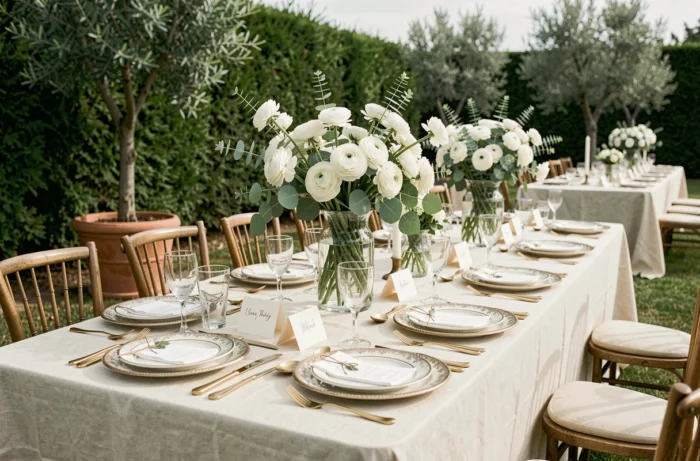
Reducing the guest list is the only lever that simultaneously affects all budget items. Fewer guests mean a smaller venue (thus cheaper or higher quality for the same budget), fewer centerpieces, fewer invitations, and fewer guest favors.
Recent data shows that couples prefer to finance an immersive experience for fewer guests rather than a standard format for one hundred people. This choice transforms the nature of the wedding: the ceremony can become more intimate, exchanges longer, and personalization finer (menu tailored to the actual tastes of those present, free seating, shared activities).
- A wedding of forty people allows for a five-course tasting menu where one hundred guests would require a buffet.
- The speaking time during the secular ceremony can be extended without tiring the audience.
- Vendors (photographer, DJ) work under more favorable conditions with a smaller group.
The cost per guest exceeds two hundred euros on average according to several recent French estimates. Each name removed from the list thus frees up a concrete amount that can be reinvested in the quality of the overall experience. The most structuring trade-off of a personalized wedding does not concern decoration or the choice of the dress: it revolves around the number of people seated at the table.