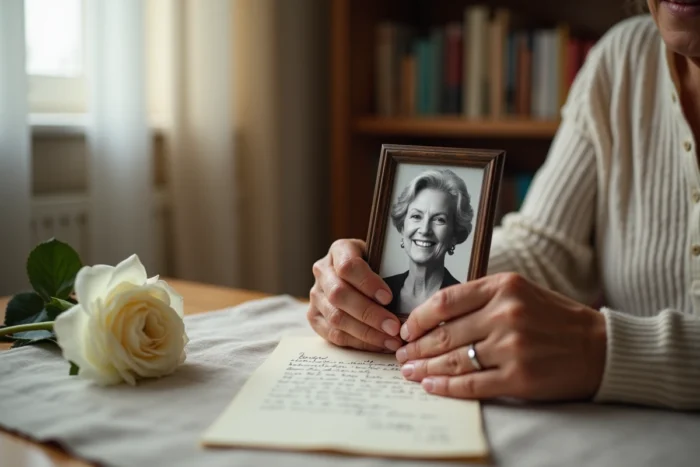
Losing a mother leaves a void that words cannot fill, but poetry allows us to structure what overflows. Reading a poem as a family during a ceremony or on a death anniversary provides a common framework for emotions that are often solitary. Choosing the right text, one that resonates with the specific memory of a departed mother, requires understanding what poetry can truly convey in a moment of collective mourning.
What funeral poetry changes in the family grieving process
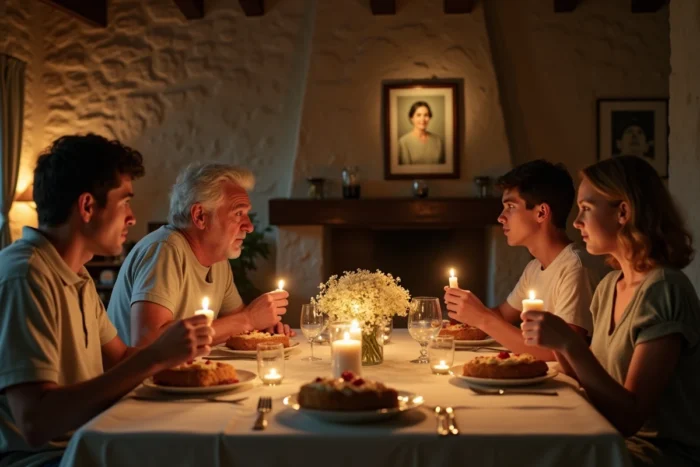
A poem read aloud during a ceremony serves a different purpose than a text read alone at home. When several family members listen together to the same verses, the text becomes a shared reference point. Each person projects their own memories onto it, but the simultaneous listening creates a form of emotional synchronization.
This collective dimension explains why certain poems transcend generations within the same family. A text chosen for the funeral can be reread on an anniversary, engraved on a gravestone, or copied into a notebook passed down to grandchildren. The poem becomes an object of family memory, not just a temporary support.
The distinction between a prose tribute and a poem lies in the musicality. The verses, even free ones, impose a reading rhythm that slows down the flow, forcing pauses between phrases. For a family gathered in emotion, this rhythm has a concrete effect: it prevents the reading from turning into a mere speech. You can also read on Maman Anonyme examples of poems designed for these specific moments.
Poem for a deceased mother: choosing a text suitable for the ceremony
Not all mourning poems are suitable for every context. A text read during religious funerals will have a different tone than a poem shared during an intimate family gathering months after the death.
Funerals and official ceremonies
For a farewell ceremony, families often turn to classic authors. Victor Hugo, with “Demain dès l’aube,” remains one of the most read texts at funerals in France. Simone Weil, with “Il restera de toi,” offers a different perspective: what matters is not what we keep but what we have given.
The choice also depends on who will read it. A child, a teenager, or an adult will not have the same ease with a complex text. A poem that is too long or has overly sophisticated vocabulary may put the reader in difficulty, diverting attention from the tribute itself.
Private family moments
Apart from the official ceremony, poetry finds its place during more intimate gatherings. Some families establish an annual ritual: rereading a poem on the anniversary of the deceased mother, or on Mother’s Day. In this context, more personal texts, even written by a family member, are entirely legitimate.
- Classic poems (Hugo, Weil, Éluard): suitable for formal ceremonies, their notoriety facilitates collective recognition and avoids misunderstandings about the tone
- Contemporary texts or song excerpts: more emotionally accessible, they are suitable for informal family gatherings where everyone can react freely
- Poems written by a loved one: the most personal, they require courage to read but anchor the tribute in the family’s concrete experience
Writing your own tribute poem to your mother
Most online articles offer ready-to-use texts. However, personal writing remains the most impactful approach, even without particular literary talent. A clumsy but sincere poem touches more than an elegant but generic text.
Starting from a specific sensory memory works better than trying to express an abstract feeling. The smell of a dish your mother used to prepare, the sound of her footsteps in the hallway in the morning, the texture of a garment she often wore: these concrete details give the poem a truth that conventional phrases (“I miss you,” “rest in peace”) cannot reach.
Here are some guidelines for structuring a personal text:
- Start with a specific memory, not an emotion. The emotion will come naturally during the reading
- Limit the text to about fifteen lines. A poem read in one to two minutes has more impact than a three-page text
- Read the text aloud before the scheduled day, ideally in front of a trusted person, to identify passages where the voice might break
- Accept that the text doesn’t need to rhyme. Free verse poetry allows for more sincerity in the message
Tribute at the grave: what regulations allow
The poetic tribute is not limited to the oral. Engraving an excerpt of a poem on a gravestone, leaving a laminated letter or a child’s drawing on the grave are common gestures. However, the cemetery manager may remove items deemed non-compliant or too bulky.
Families wishing for a luminous tribute (lanterns, candle holders, candles) generally have some leeway, but permanent electrical installations often require prior authorization from the town hall. These practical details should be checked before organizing a family gathering around the grave.
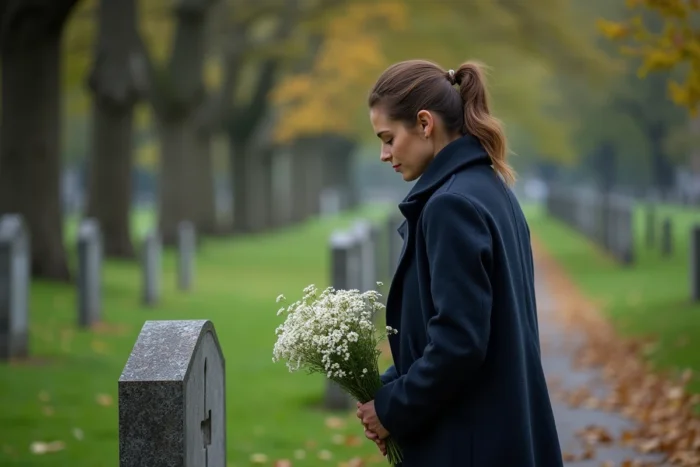
For families whose mother was cremated, the question of the tribute location arises differently. Since the 2008 law, ashes can no longer be kept at home permanently: they must be scattered in an authorized site or placed in a columbarium. The poem can then accompany the moment of scattering, read facing the sea, in a memory garden, or in a place that was significant to the departed mother.
The text chosen for this moment benefits from being short. Two or three stanzas are sufficient. The outdoor environment (wind, background noise) makes long texts difficult for the gathered loved ones to follow. A brief poem, read slowly, carries more weight than a lengthy reading drowned out by the elements.
Poetry does not heal the mourning of a mother. It offers a framework to express what would otherwise remain unspoken. A verse reread ten years later can revive a memory with a precision that memory alone would have allowed to fade.