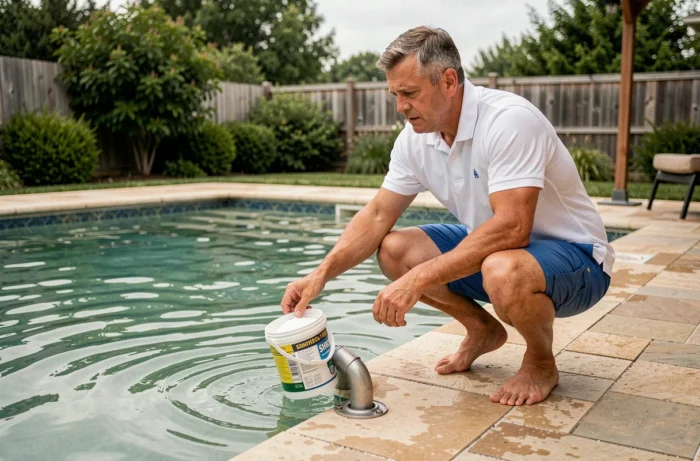
You return from vacation, the pool water has turned green, and the instinct seems logical: pour a dose of shock chlorine directly into the skimmer to quickly solve the problem. This gesture, very common, however exposes your system to mechanical and chemical damage that most pool owners discover too late. Shock chlorine in the skimmer does not disinfect better; it concentrates an aggressive product where your equipment is most vulnerable.
Chlorine concentration in the skimmer: what happens concretely
The skimmer is a small volume of water, connected by a narrow pipe to the pump and then to the filter. When you place shock chlorine (granules or fast-dissolving tablets) in it, the product releases a massive amount of active chlorine in this confined space.
As long as the filtration is running, part of the product is sucked into the circuit. But as soon as the pump stops (at night, during a power outage, or between two filtration cycles), the chlorine continues to dissolve. It then stagnates in the skimmer basin and in the pipe that connects the skimmer to the pump.
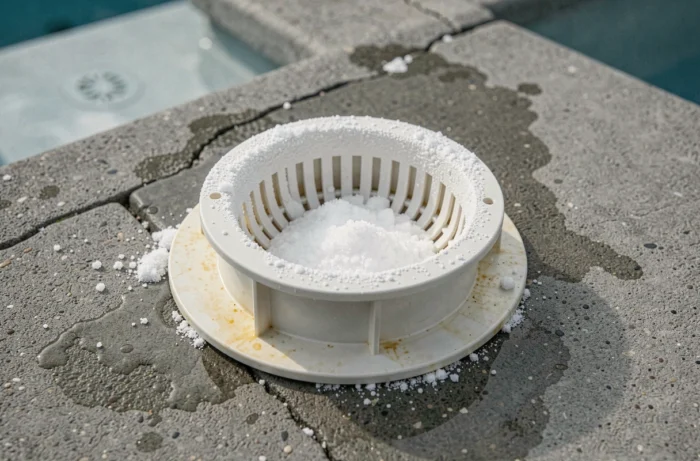
The local concentration can reach levels far above normal. This over-chlorinated water remains in prolonged contact with the plastic basket, the seals, the PVC pipe, and the pump’s pre-filter. It is during this stop phase that the damage accumulates, often without immediate visible signs.
Many owners choose to use shock chlorine in the skimmer for convenience, without realizing that the real problem is not the chlorine itself but its concentration in a confined space.
Damage to pipes and pool pump
The first component affected is the skimmer basket. The plastic dries out, becomes brittle, and eventually cracks. It is not the most expensive part, but it is a warning sign.
The serious problem lies further down the circuit. The PVC pipe between the skimmer and the pump undergoes accelerated chemical corrosion. The concentrated chlorine attacks the inner wall of the pipe, causing invisible micro-cracks from the outside, and then leaks. Detecting and repairing a leak in an underground pipe costs much more than a properly dosed treatment.
Pump and pre-filter: the most exposed parts
When the pump restarts after a stop, it first sucks in the stagnant water from the skimmer, which contains the highest concentration of chlorine. The o-ring of the pre-filter, the pump body (especially if plastic), and the mechanical seal receive this chemical spike with each cycle.
- The o-rings lose their elasticity and no longer ensure a seal, causing air intake in the circuit.
- The plastic pump body can discolor, become porous, and then crack after several seasons of exposure.
- The mechanical seal (wear part between the motor shaft and the hydraulic body) degrades faster, leading to leaks at the motor.
Replacing a filtration pump represents a significant budget item, not to mention the downtime of the pool during the intervention.
Shock chlorine and automatic cover: a risk often ignored
Do you have an automatic cover or a rolling shutter? This point deserves special attention. After a shock treatment, the chlorine level in the water remains high for several hours.
If you close the cover right after the treatment, the concentrated chlorine remains trapped under the cover without ventilation or dilution by UV. Manufacturers of automatic covers recommend keeping the pool open until the residual chlorine level has dropped back into the normal range. This is not a matter of fixed time (waiting 24 hours, for example), but of actual measurement with a reliable tester.
The high chlorine attacks the slats of the shutter, discolors the covers, and weakens the fastenings. Combined with pouring into the skimmer (which creates an even stronger concentration spike at the start of filtration), the risk of accelerated deterioration of the cover is real.
Pool shock treatment: the correct dissolution method
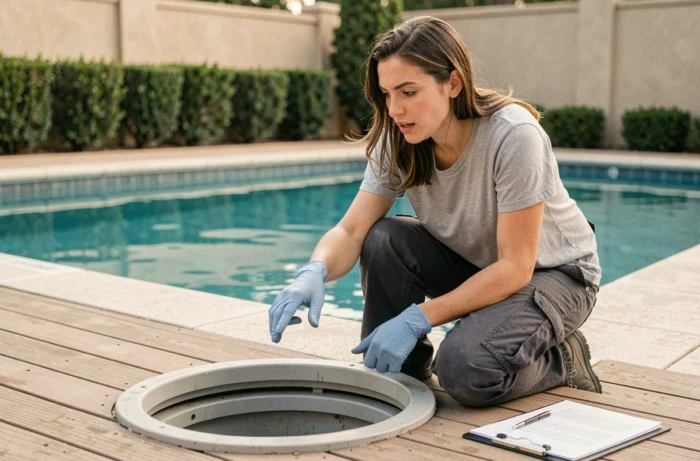
Shock chlorine is designed to be diluted in a large volume of water, not in the small reservoir of the skimmer. The recommended method is simple.
Fill a bucket with pool water. Pour the dose of shock chlorine suitable for the volume of your pool into it. Mix, then distribute the mixture directly into the pool, preferably in front of the return jets, with filtration running. The product dissolves immediately throughout the entire volume of water.
What shock chlorine does not solve
One point that recent guides emphasize: if your skimmer is not sucking well, if the basket is clogged, or if the filtration flow is low, adding shock chlorine will change nothing. Shock chlorination addresses a biological problem (algae, bacteria), not a mechanical problem. Before any treatment, check that the hydraulic circuit is functioning normally.
Similarly, shock chlorine should not be introduced into a chlorinator (or automatic doser) designed for slow-dissolving tablets. The two products do not have the same dissolution speed or concentration. Mixing types of chlorine in the same device can cause undesirable chemical reactions.
Regular pool maintenance: slow chlorine and skimmer, what compatibility?
The confusion often arises from the fact that some owners place slow-dissolving (stabilized) chlorine tablets in the skimmer for weekly maintenance. This practice, although less risky than a shock, poses the same local concentration problems when the pump stops.
The most reliable solution remains the floating doser or the inline chlorinator, installed after the filter and before the return to the pool. These devices regularly diffuse the product throughout the entire volume of water, without creating a zone of over-chlorination.
- The floating doser is suitable for small pools and requires no installation.
- The inline chlorinator, connected to the return circuit, offers a more homogeneous dosage for medium and large pools.
- In both cases, the skimmer remains dedicated to its original function: sucking up surface impurities, not storing treatment products.
Regular maintenance with properly diffused chlorine reduces the need for shock treatment. Fewer shocks mean less chemical stress on the equipment, more stable water, and a pool that ages better.