
Textile dyeing represents a significant portion of water pollution on a global scale. Synthetic dyes, often composed of heavy metals, formaldehyde, or phthalates, contaminate waterways and expose workers as well as consumers to documented health risks. Dyeing or reviving a garment in black, a color that typically requires high concentrations of dyes, raises the question of less toxic alternatives with particular urgency.
Supercritical CO₂ dyeing: an industrial technology still little known
Plant-based recipes using gall nuts, indigo, or walnut husks cater to artisanal and domestic use. On an industrial scale, a distinct technology is advancing: supercritical CO₂ dyeing.
The principle relies on carbon dioxide subjected to high pressure and high temperature, a state known as “supercritical” where it acquires solvent properties. The dye dissolves in this CO₂, penetrates the fiber, and then the gas is depressurized and recycled. The process works without water or with very little water, eliminating the problem of contaminated effluents.
Limitations exist. The equipment requires a heavy investment, and compatibility with all fibers remains a subject of development. Field reports vary on the depth of black obtained depending on the type of textile. For those looking to reduce the footprint of mass production, this avenue is worth pursuing, even if it does not yet replace conventional processes everywhere.
Alongside these industrial advances, several resources compile options accessible to individuals. Notably, information on Les Galeries de la Mode details less toxic alternatives for common textiles.

Fixing black on textiles: salt, vinegar, or dedicated fixer
Achieving a deep black is pointless if it bleeds out after the third wash. Fixation is the weak link in eco-friendly dyeing, and the advice circulating often oversimplifies reality.
Cellulosic fiber or animal fiber: two distinct logics
Cotton, linen, and viscose are cellulosic fibers. For these materials, salt (sodium chloride) in the dye bath promotes the migration of the dye to the fiber. Wool and silk, protein fibers, respond better to an acidic environment: white vinegar acts as a mordant.
Mixing the two protocols, as some guides do, leads to mediocre results. A salt bath on wool will not improve fixation, and a vinegar bath on cotton will remain insufficient.
The liquid fixer, more reliable than home remedies
Feedback from specialized haberdasheries indicates that a specific liquid fixer stabilizes black dye on cotton better than a simple vinegar bath. This type of product, sold as a complement to textile dyes, forms a stronger chemical bond between the pigment and the fiber. The additional cost is modest compared to the risk of having to start over.
- On cotton or linen: salt in the dye bath, then cold rinsing. A dedicated fixer improves retention.
- On wool or silk: white vinegar in the bath, controlled temperature to avoid felting the fiber. Gentle handling, without twisting.
- On synthetic fibers (polyester, nylon): most plant-based dyes do not adhere. Only certain low-toxicity chemical formulations, or the supercritical CO₂ process, allow for a stable result.
Plant-based black pigments: what “natural” black really means
Absolute black does not exist in plant dyeing. What is obtained lies between a very dark gray and a slightly bluish or brownish black, depending on the pigment source and the mordant used.
Historical recipes combine two steps: a tannin bath (gall nuts, oak bark, walnut husks) followed by a passage through an iron bath (ferrous sulfate). The tannin-iron combination produces dark complexes on cellulosic fibers, but the result varies significantly depending on concentration, immersion time, and water quality.
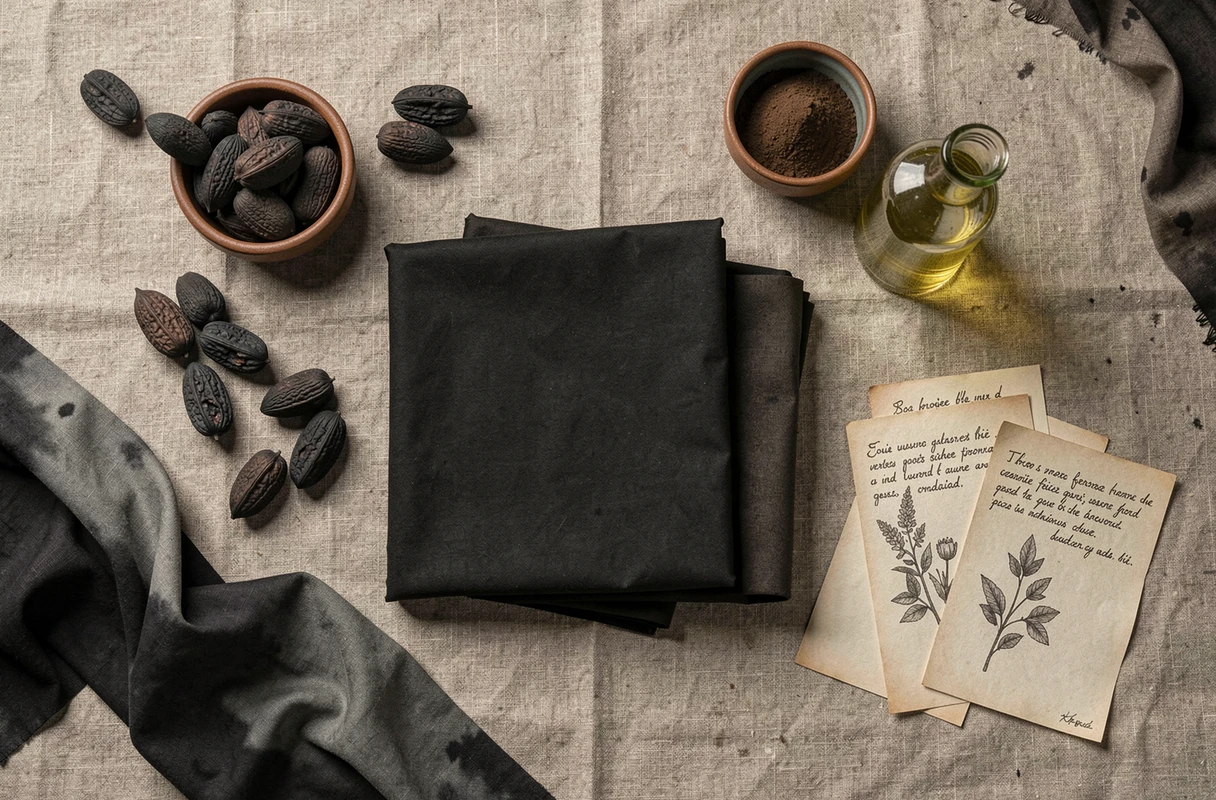
For cellulosic fibers like cotton, the process takes at least three days between degumming the fabric, extracting the tannins, dyeing, and modifying with iron. Some add an overdye with indigo to deepen the black. The time invested is real, and the final result does not compete with the uniformity of a synthetic dye.
On an industrial scale, players are working on bio-sourced black pigments designed to replace carbon black. These pigments, of biological origin, target large-scale textile applications. The available data does not yet allow for conclusions about their large-scale adoption, but the sector is becoming structured.
Care for dyed black: UVs matter as much as washing
A garment dyed black with an eco-friendly dye loses its intensity faster than a garment dyed industrially, with equal care. Several factors accelerate this degradation.
- Hot washing destroys the pigment-fiber bonds. A cold or lukewarm wash (maximum 30 °C) preserves the color.
- Intensive spinning creates mechanical friction that pulls the pigment from the surface. Reducing the spin speed limits this effect.
- The tumble dryer combines heat and friction, two enemies of black. Air drying, in the shade, remains the best option.
- Direct sunlight UVs degrade natural pigments faster than synthetic dyes. Drying inside out and in the shade visibly prolongs the retention of black.
Turning the garment inside out before each wash and using a gentle detergent, without bleaching agents, complements these precautions. No perfect maintenance will make a plant-based black as stable as a synthetic black over five years, but these actions tangibly reduce the gap.
Eco-friendly black dyeing lies between two realities: accessible artisanal processes that are time-consuming and demanding in rigor, and promising industrial technologies whose deployment remains partial. Choosing one or the other depends on the scale of the project and the level of black expected. Adapting the dyeing protocol to the fiber used and maintaining rigorous care remain, at this stage, the two most reliable levers for achieving a durable black.