What clothing pieces truly defined the year 1994, and how does this year stand out from the rest of the 1990s decade? Between the crystallization of grunge style on the runways, the emergence of a controversial baby-doll, and collections that have become museum references, 1994 concentrates precise shifts in the history of fashion. This article compares the dominant trends of this pivotal year and measures their impact on today’s fashion vocabulary.
Alternative baby-doll vs. Calvin Klein minimalism: two opposing visions in 1994
The year 1994 pits two radically different stylistic proposals against each other. On one side, Anna Sui’s spring-summer 1994 collection codifies the so-called “alternative” baby-doll: short dresses, nostalgic femininity, references to music culture rather than classic glamour. This collection was included in the Camp: Notes on Fashion exhibition at the Metropolitan Museum of Art in 2019, proving its cultural significance.
On the other side, Calvin Klein continues his clean line, with straight cuts, neutral palettes, and an aesthetic that emphasizes simplicity. The contrast between these two approaches encapsulates the tension that permeates fashion in 1994.
| Trend | Silhouette | Cultural References | Iconic Designer |
|---|---|---|---|
| Alternative baby-doll | Short dresses, cardigans, quirky jewelry | Alternative music, childhood nostalgia | Anna Sui |
| Minimalism | Straight cuts, clean lines | Contemporary art, photography | Calvin Klein |
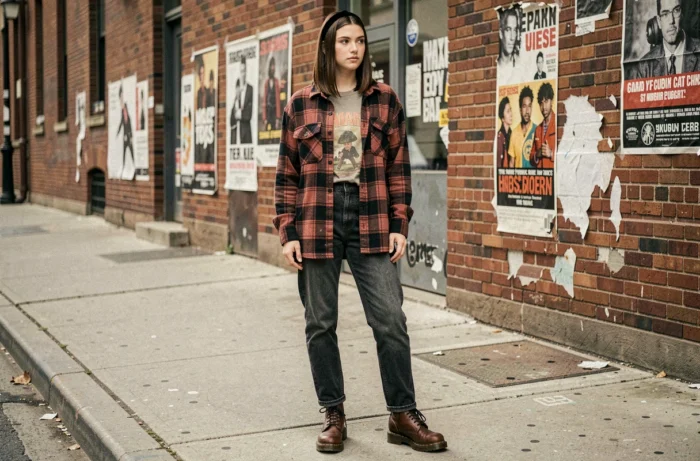
| High fashion grunge | Layering, flannel, faded jeans | Independent rock, Seattle | Marc Jacobs (1993 legacy) |
| Theatrical glamour | Structured dresses, historic draping | Renaissance, opera | John Galliano |
By exploring the fashion and looks of 1994, we see how these trends coexist without canceling each other out. It is this plurality that distinguishes 1994 from other years in the decade, where a single movement tends to dominate the media narrative.
Baby-doll dress in 1994: fashion piece or provocation according to the press
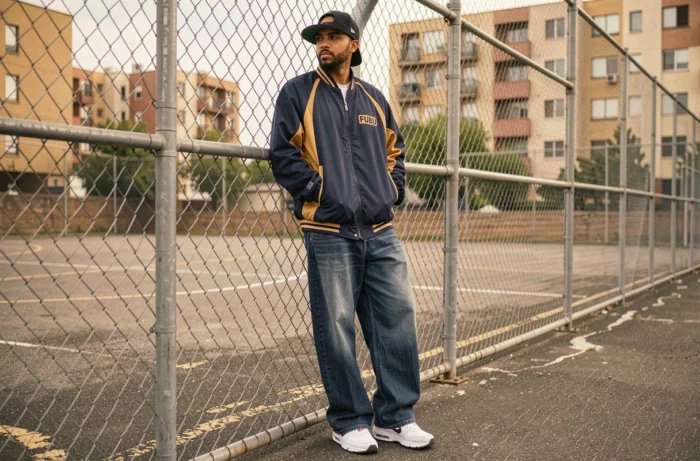
The baby-doll does not achieve consensus in 1994. Fashion critic from the New York Times, Suzy Menkes, describes the baby-doll dresses that year as “party frocks with little-girl cardigans and mommy-dress-up jewelry.” She publicly questions the “perverse” nature of adult women wearing children’s clothing.
This media reception contrasts with the enthusiasm of designers. Both Anna Sui and Giorgio Armani adopt the baby-doll in their collections, but for different reasons. For Sui, the baby-doll dress expresses a rebellious femininity linked to the music scene. For Armani, it fits into a more structured wardrobe, far from subversion.
The 1994 debate around the baby-doll reveals a recurring gap between the vision of designers and the interpretation by mainstream media. What the runways present as a visual vocabulary, critics perceive as a regression.
Why this controversy marks a turning point
The year 1994 is one of the first where the mainstream press directly questions the intentions of designers regarding gender and age. The baby-doll becomes a battleground between aesthetic interpretation and sociological reading, a pattern that will regularly recur in the following decades.
John Galliano’s fall 1994 collection: theater as a method of creation
John Galliano presents his Princess Lucretia collection in 1994, which will be described as a foundational moment in his career. This collection draws from the iconography of the Italian Renaissance, featuring draping, heavy fabrics, and a staging reminiscent of live performance.
Galliano transforms the runway into theatrical narration, countering the prevailing minimalism. Where Calvin Klein strips down, Galliano layers up. The contrast is all the more pronounced as these two proposals coexist in the same season.
- Corset dresses inspired by Quattrocento painting, with puffed sleeves and damask fabrics
- Staging of the show as a living tableau, breaking with the usual linear format
- Historicizing fashion vocabulary that foreshadows Galliano’s Dior collections at the end of the 1990s
The 1994 Princess Lucretia collection functions as a laboratory. The codes that Galliano establishes (theatricality, historical references, embraced excess) become his signature when he takes over the artistic direction of Dior a few years later.
High-waisted jeans and accessories from 1994: what remains in current wardrobes
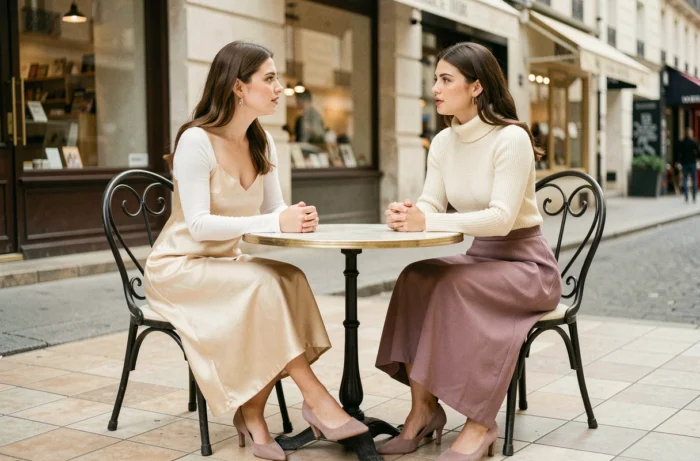
High-waisted jeans, already present at the beginning of the decade, reach standard piece status in 1994. Brands like Levi’s maintain the 501 as a reference, while designers incorporate it into more structured silhouettes.
Accessories from 1994 prioritize functionality over decoration. Sunglasses adopt various shapes, from thin frames to wraparound models. Bags remain compact. The voluminous blowout, often associated with the supermodels of the time, completes a silhouette that emphasizes verticality.
1994 pieces still worn today
Some proposals from 1994 can be found in contemporary collections without major modifications:
- The high-waisted 501 jeans, regularly brought back into production by Levi’s and becoming an intergenerational staple
- Oversized blazers, adopted by brands like Tommy Hilfiger in their current lines
- The crop top paired with high-waisted bottoms, a combination that cyclically returns in women’s fashion
- Sneakers worn in non-sport contexts, a usage already common in 1994 and now normalized
The wardrobe of 1994 functions as a reservoir of basics for current fashion. What distinguishes these pieces from mere cyclical trends is their lasting integration into wardrobes, beyond nostalgia effects. The designers of 1994 set fashion standards that three decades have not rendered obsolete.