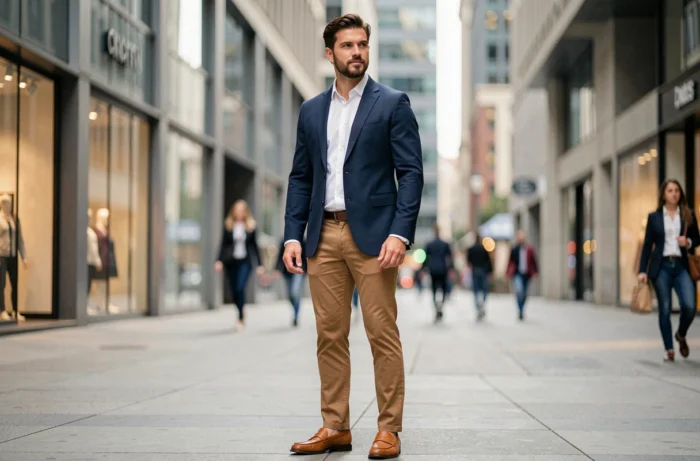
A white t-shirt, a pair of raw jeans, and white sneakers: this trio has long summarized the default male wardrobe. For a few seasons now, the boundaries have been shifting. Men are venturing into previously marginal territories, from anti-aging serums to clothing cuts borrowed from the female wardrobe, without it feeling like a stance. Understanding what is truly changing helps in making more coherent fashion and cosmetic choices.
Dermocosmetic Care for Men: Clinical Routine Replaces Simple Shower Gel
Have you noticed that the “men’s” sections in pharmacies no longer just include deodorant and shaving foam? The segment of men’s dermocosmetics now accounts for over $115 billion globally. Skincare is no longer an accessory gesture; it is an accepted expense.
The primary concern is anti-aging: retinol, peptides, eye contour. Men under forty in developed countries are now the majority using at least three skincare products regularly, compared to fewer than one in four ten years ago. This shift is not anecdotal: it signifies that a multi-step routine (cleanser, active serum, moisturizer with SPF) has become the norm in this age group.
The key phrase here is “science-based.” Clinical formulations, with precise concentrations of active ingredients, have taken precedence over marketing creams with masculine names. A serum based on niacinamide or hyaluronic acid is chosen not by its packaging but by its INCI list. To keep up with the developments in this market and find concrete comparisons, masculin.info regularly publishes guides focused on these skincare and style questions.

Men’s Fashion and Neo-Masculine Codes: How a Less Normative Wardrobe Changes Daily Life
The term “neo-masculine” often comes up to describe a style code that redefines men’s fashion. In practical terms, this translates into a wardrobe where the boundary between masculine and feminine becomes a playground rather than a rigid line.
Fluid Silhouettes and Mixed Textures
Recent fall-winter collections from luxury brands incorporate wide pleated trousers, oversized coats, and fine knits worn close to the body. The idea is not to feminize the wardrobe but to expand the range of cuts accessible to men. A loose wool trouser worn with a fitted sweater creates a contrast of volumes that structures the silhouette without stiffening it.
Materials also play a role. Satin, blended silk, and fine corduroy appear in everyday pieces, not just in evening wear. Fabric becomes a tool of expression just like cut.
Three Guidelines to Adapt This Trend Without Faux Pas
- Start with a single “offbeat” piece in a sober outfit: a blended silk shirt with classic jeans, for example, is enough to make a statement without overwhelming
- Favor fitted cuts when the fabric is fluid, and vice versa: the contrast between structure and flexibility avoids a costume-like effect
- Pay attention to the quality of the drape rather than the price: cheap polyester in a loose cut gives a flat appearance, whereas thick cotton or lightweight wool maintains its shape
Men’s Well-Being: Beyond Physicality, a Lifestyle to Recalibrate
Well-being for men is not limited to the gym and protein powders. What has emerged over the past two years is a more holistic approach where recovery matters as much as effort.
Sleep has become a performance topic, not just a comfort issue. Sleep trackers, magnesium-based supplements, and “wind-down” protocols (decompression routines before bed) are gaining traction. Why this change? Because the culture of maximum productivity has shown its limits: chronic fatigue, decreased concentration, irritability.
The practice of sports itself is evolving. The “all cardio” or “all strength training” model is giving way to hybrid combinations. A concrete example: alternating short strength training sessions with joint mobility and long walks. The goal is no longer just to look fit, but to be sustainably fit.

Style and Social Media: How to Filter Inspiration Without Succumbing to the Algorithm
Instagram and Pinterest remain the dominant platforms for men’s fashion inspiration. The problem is not the lack of content, but the excess. Algorithms favor viral posts, not those most relevant to your body type or budget.
Some habits can help regain control of your feed:
- Follow accounts that showcase outfits worn in real life, not just studio shoots. Men’s fashion blogs and YouTube creators filming in natural light provide a more reliable idea of how a garment looks
- Save posts instead of liking them: on Instagram, saving carries more weight in the algorithm and refines recommendations
- Limit sources to about ten reference accounts to avoid visual overload that leads to impulsive buying
Building a personal style is about subtraction, not accumulation. Fewer pieces, better chosen, worn more often: this logic applies to both the wardrobe and social media subscriptions.
Fashion, well-being, and lifestyle trends for men converge on the same principle: precision outweighs volume. A well-measured serum rather than five generic creams, a streamlined wardrobe rather than an overflowing closet, a calibrated workout routine rather than an unused gym membership. The most useful choice remains the one we actually apply, week after week.