
When deploying a generative AI tool in a marketing team or a legal department, the first question is no longer “which model to choose” but “are we allowed to use it this way.” The tech trends of 2024 are not just a list of gadgets: they play out in the regulatory field, in cloud decisions, and in how companies actually absorb these technologies on a daily basis.
European AI Act: what the regulation concretely changes for tech projects
The European regulation on artificial intelligence, known as the AI Act (EU) 2024/1689, came into effect on August 1, 2024. The legal framework for AI is no longer a distant draft directive; it is an applicable text that is gradually being implemented until 2027.
On the ground, the direct consequence is the obligation for each organization to map its AI use cases according to a risk level grid: unacceptable, high, limited, or minimal. An automated HR scoring system, for example, is not managed like a reception chatbot.
The penalties can reach 35 million euros or 7% of global revenue for the most serious violations. In practice, we already see tech teams suspending pilot projects while they verify their compliance. Feedback on this point varies, with some organizations absorbing the audit without difficulty, while others had to revise their entire data processing chain. To keep up with these developments and other tech news on mrfreefree.com, regulatory monitoring is becoming as much an operational reflex as a technological one.
Generative AI in business: beyond the prototype, the real field decisions
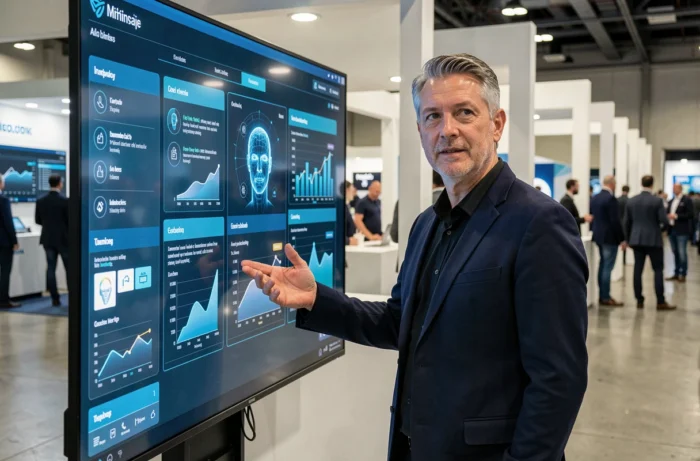
The majority of articles on technology trends for 2024 describe generative AI as a creative revolution. In reality, the situation is more granular. It is observed that companies that derive measurable benefits from these tools are those that have framed three elements before launching anything.
Choosing between proprietary model and open-source model
A proprietary model hosted by a cloud provider simplifies deployment but raises questions of dependency and recurring costs. An open-source model requires internal skills for fine-tuning, hosting, and maintenance.
The choice depends on the volume of data processed and the level of confidentiality required. A small business generating product sheets does not have the same constraints as a law firm analyzing sensitive contracts.
Integrating AI into existing workflows without breaking everything
Generative AI works when it is integrated into an existing process, not when it replaces it overnight. Successful teams start with a unique use case (writing briefs, summarizing meetings, ticket classification) and measure the real gain before expanding.
A common mistake is deploying a cross-functional AI assistant without training users to formulate actionable prompts. The result is an underutilized tool after three months.
Sovereign cloud and data management: a topic that has become operational
The question of the cloud in 2024 is no longer “should we migrate” but “where to host what.” With the gradual implementation of the AI Act and the enhanced requirements of the GDPR, the choice of cloud infrastructure directly conditions regulatory compliance.
There is a clear segmentation in practices:
- Personal data and high-risk AI models are migrating to qualified cloud solutions hosted in Europe to meet digital sovereignty requirements.
- Less sensitive workloads (websites, consumer applications, testing environments) remain with American hyperscalers for cost and performance reasons.
- Hybrid architectures are becoming widespread, with an orchestrator distributing loads according to the sensitivity of the processed data.
This segmentation is not theoretical. It structures calls for tenders and IT budgets starting this year.

Sustainable technologies and energy efficiency of data centers
The massive deployment of generative AI models has a direct collateral effect: the energy consumption of data centers is increasing significantly. Training and running language models requires computing power that impacts bills and carbon footprints.
On the ground, technical responses are structured around several axes. Liquid cooling is gaining ground in high-density data centers. Software optimization (model quantization, inference on specialized chips) allows for reduced consumption per request without degrading the quality of results.
For companies, the question arises as early as the choice of cloud provider: what is the energy policy of the data center hosting our services? Certifications and commitments to carbon neutrality are becoming selection criteria on par with latency or price per gigabyte.
Cybersecurity and AI: an expanded attack surface
Each new artificial intelligence tool deployed in an organization represents a potential entry point. Risks such as prompt injection attacks, manipulation of training data, or extraction of sensitive data via a poorly configured model are documented risks.
The security of AI systems is addressed from the design stage, not as a corrective measure. Security teams are now integrating specific tests for AI models into their audits: verification of datasets, access control to APIs, monitoring of model outputs to detect information leaks.
The AI Act reinforces this logic by imposing technical documentation, traceability, and human oversight obligations on systems classified as “high risk.” For security managers, this is a concrete lever to obtain budget and structure their practices.
The tech trends of 2024 share a common thread: technology alone is no longer enough; it is its governance that makes the difference. Between regulatory compliance, infrastructure decisions, and energy management, technical choices have become strategic decisions that engage the organization far beyond the IT department.