
Converting 400 ml to liters involves a single operation: dividing by 1000. The result, 400 ml = 0.4 liters, may seem trivial. The real challenge is not the calculation itself, but its repeated application in contexts where units mix: recipes alternating between centiliters and milliliters, food labels in volumes and scales in grams, dosages of household products expressed in dilutions.
This article measures the discrepancies between conversion methods and identifies those that reduce the risk of error in daily life.
Comparison Table of Conversion Methods from ml to Liters
Three approaches are commonly found in educational resources for converting milliliters to liters. Each has a different cognitive cost depending on the situation.
| Method | Principle | Reliability | Main Limitation |
|---|---|---|---|
| Division by 1000 | 400 ÷ 1000 = 0.4 L | Exact every time | Requires calculation for non-round values |
| Decimal Shift | Shift the decimal 3 places to the left: 400.0 → 0.400 | Exact if the number of places is respected | Common error of one place (result 4.0 instead of 0.4) |
| Conversion Table | Place the unit digit in the ml column, read the value in the L column | Exact and visual | Requires having the table in view or knowing it by heart |
The conversion table remains the recommended method by recent educational resources, as it makes the transition between columns visible and reduces errors in decimal placement. For quick daily use, the decimal shift remains the most practical, provided one consistently counts three places.
If you’re looking to understand how to convert 400 ml to liters with a step-by-step detail, the logic always rests on this single factor: 1 liter = 1000 milliliters.
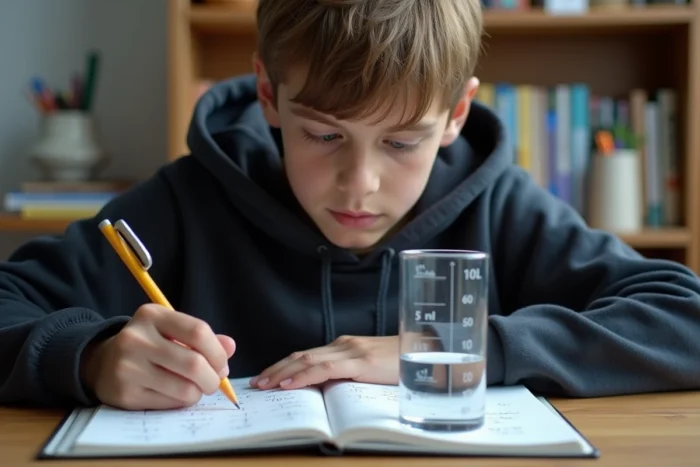
Decimal Shift: Why a One Place Error Changes Everything
The decimal shift is the most commonly used technique in mental calculation. We write 400.0 and then shift the decimal three positions to the left to obtain 0.400, or 0.4 L.
The classic error is to shift only two places. The result then becomes 4.0 L, which is ten times the actual volume. In a recipe, this means pouring half a pack of milk instead of a large glass. For a diluted household product, the overdose can damage a surface or waste concentrated product.
A Concrete Reference to Avoid Mistakes
The equivalence 1 cm³ = 1 ml and 1 dm³ = 1 liter provides a physical anchor. One liter corresponds to a cube with 10 cm sides. Visualizing this object helps estimate whether the obtained result is plausible: 0.4 L represents less than half of this cube, which corresponds well to a common volume in a carton of broth or cream.
When in doubt, performing the division on paper (or on a phone screen) takes less time than correcting a failed recipe.
Conversion to Liters and Conversion to Grams: The Volume-Weight Confusion
Knowing that 400 ml equals 0.4 L says nothing about the weight of this volume. 400 ml only equals 400 g for pure water and liquids with a density close to 1. For others, the discrepancy can be significant.
- Olive oil is less dense than water: 400 ml of oil weighs significantly less than 400 g.
- Honey, being denser, far exceeds 400 g for the same volume.
- Whole milk is slightly above 400 g for 400 ml, but the difference remains small.
This distinction is absent from most online converters, which are limited to volume units. In cooking, when a recipe indicates a weight and you measure with a graduated measuring cup in milliliters, the result will be approximate for any liquid other than water.
When to Prefer the Scale Over the Measuring Cup
For ingredients whose density deviates from that of water (syrup, heavy cream, oil), the scale provides a more reliable result than reading a volume. However, for water, broth, or vinegar, the measuring cup is sufficient: the direct conversion from ml to grams remains reliable in these specific cases.
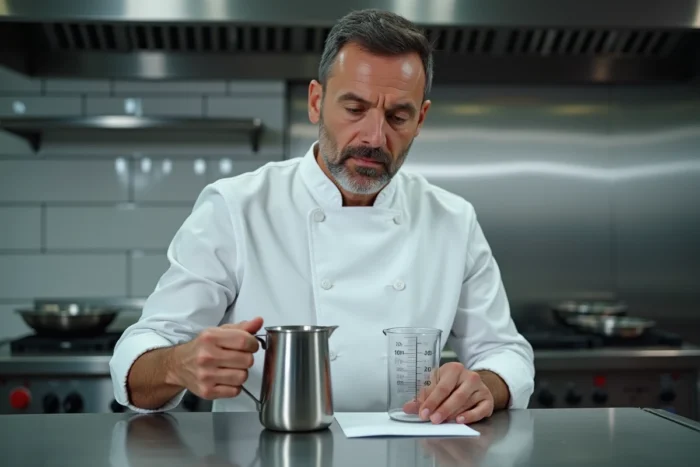
Common Volumes in Cooking: Positioning 400 ml Among Other Measurements
The volume of 400 ml is common on food packaging (cartons of cream, ready-to-use broths, certain formats of plant milk), but recipes often use other units. Positioning 400 ml within this scale avoids back-and-forth conversions.
- 400 ml = 0.4 L = 40 cl (centiliters)
- A standard table glass holds about 20 to 25 cl, meaning two full glasses are needed to reach 400 ml.
- A tablespoon represents about 15 ml: it would take more than twenty to measure 400 ml, making this tool unsuitable for this volume.
Remembering that 40 cl and 0.4 L refer to the same volume as 400 ml simplifies the cross-reading of recipes, where all three notations often coexist on the same page.
Online Conversion Tools: Precision vs. Practicality
The converters available on the web provide an instant result for the ml-liter relationship. Their real utility appears mainly for non-round values (378 ml, 1250 ml) where mental calculation hesitates.
For 400 ml, a converter offers nothing that the decimal shift doesn’t accomplish in two seconds. However, these tools remain limited when it comes to relating a volume to a weight, as they generally do not take into account the density of the measured liquid.
The most robust approach combines two reflexes: divide by 1000 for volume, weigh for weight. The first can be applied without tools, while the second requires a kitchen scale. Between the two, the graduated measuring cup in ml and cl covers the majority of everyday needs without calculation.