
Cellular concrete is easy to drill, provided it is not treated like traditional concrete. This material, made of sand, lime, and cement, lightened by millions of microbubbles of air, reacts poorly to tools and settings designed for dense substrates. Using too much percussion or an unsuitable drill bit causes chipping, oval holes, or even cracking of the tile. Adapting the tool to the material, and not the other way around, remains the key to achieving a clean hole.
Why cellular concrete breaks when drilled improperly
The honeycomb structure of cellular concrete gives it its lightness and insulating properties, but it also makes it brittle under localized mechanical stress. A standard concrete drill bit with a carbide head designed to tackle dense aggregates concentrates too much energy on a material that offers almost no resistance.
The percussion mode exacerbates the problem. Each impact causes the walls of the cells around the drilling point to burst, which irregularly enlarges the hole. On a modestly thick partition tile, the vibration can spread to the edge and cause a through crack.
To drill cellular concrete cleanly, it is essential to select a drill bit suitable for soft materials and to systematically disable the percussion of the drill. This simple action radically changes the outcome.
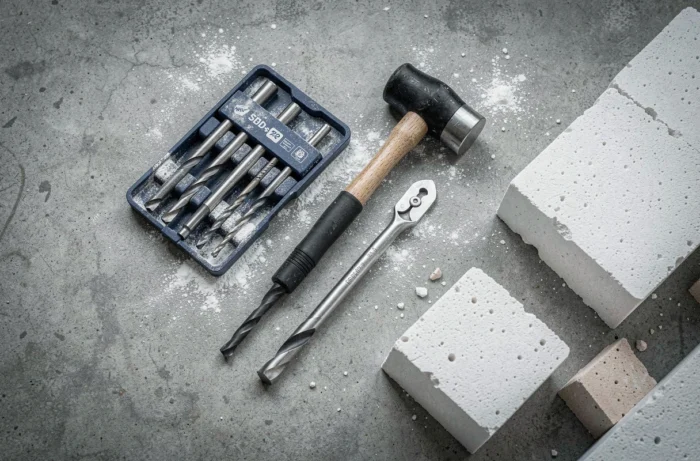
Drill bits and tools suitable for cellular concrete: carbide, tungsten, or steel
The choice of drill bit determines the quality of the hole far more than the power of the machine. Three families of tools cover the majority of scenarios on cellular concrete.
Soft material drill bit with carbide tip
This is the most common option. A so-called “universal” or “multi-material” drill bit with a tungsten carbide tip with a gentle geometry (a more open attack angle than a standard concrete drill bit) passes through cellular concrete without chipping. The rotation speed should remain moderate to avoid overheating, which weakens the tip and the material.
Wood or metal drill bit in high-speed steel
On low-density cellular concrete, a standard wood drill bit works for small diameter point drilling. High-speed steel wears out faster than carbide in this context, but it is sufficient for fixing a few shelves. Field reports vary on the durability of this solution beyond a dozen holes.
Core bit or hole saw for large diameters
For electrical conduit or ventilation duct: once the diameter exceeds twenty millimeters, the carbide segment core bit replaces the drill bit. A light masonry hole saw is also suitable, provided it is used without percussion and at a reduced speed.
- For a standard fixing hole: multi-material drill bit with carbide tip, drill in rotation mode only.
- For a conduit or duct: carbide core bit or hole saw, slow speed, constant pressure without forcing.
- For a point adjustment: wood drill bit in high-speed steel, acceptable for a few drillings but to be replaced if the tip becomes dull.
Drill settings and drilling technique on cellular tile
The tool is not everything. The machine settings and the technique condition the cleanliness of the result as much as the type of drill bit.
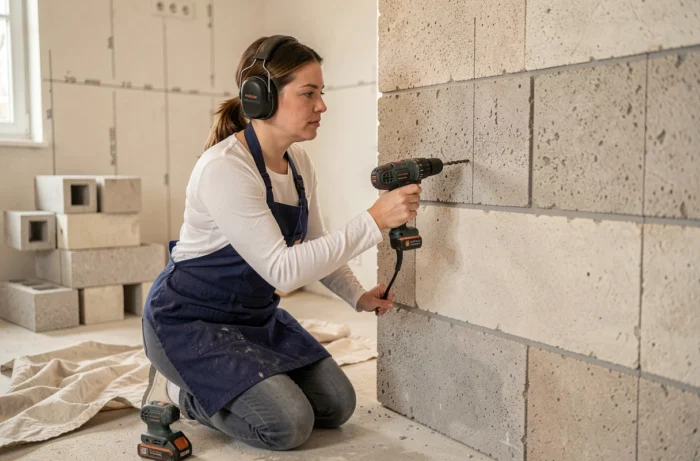
Disabling percussion is the first thing to do, regardless of the drill model. On a percussion drill or hammer drill, the “rotation only” mode (often symbolized by a drill bit without waves) is sufficient for cellular concrete. Percussion adds nothing on such a soft material and only damages the substrate.
The rotation speed should be set in the low to medium range. A speed that is too high heats the drill bit and vitrifies the surface of the hole, making the hold of the anchor unreliable. Starting slowly also helps stabilize the drill bit at the marking point and prevents it from slipping on the slightly grainy surface of the tile.
The pressure applied should remain constant and light. Cellular concrete allows for quick drilling: forcing accelerates the exit of the drill bit from the other side, causing a chip on the back face. On a thin partition tile, placing a wooden block behind the drilling point prevents this issue.
Anchors for cellular concrete: adapting the fixing to the material
Drilling correctly is pointless if the pulled-out anchor takes a piece of tile with it. Classic expansion anchors, designed for solid and resistant substrates, crush the cells of cellular concrete without creating a reliable mechanical grip.
Specific anchors for hollow or soft materials work on a different principle: they expand behind the material or anchor by friction in the thickness of the tile. Screw anchors (like helical nylon) provide good hold for light to medium loads. For heavier loads, chemical anchoring remains the most reliable solution.
Next-generation versatile anchors, such as the Fischer DuoPower, now include cellular concrete in their declared compatibility. They adapt their mechanical behavior to the encountered substrate, simplifying the choice for DIYers working with multiple types of materials.
- Light load (frame, decorative shelf): nylon screw anchor directly into cellular concrete, without pre-drilling or with a pilot hole slightly smaller than the diameter of the anchor.
- Medium load (suspended furniture, radiator): special cellular concrete expansion anchor or versatile DuoPower type anchor, with pre-drilling at the exact diameter recommended by the manufacturer.
- Heavy load (water heater, articulated TV mount): chemical anchoring with injection sleeve to distribute the resin into the cells of the material.
Dust management and finishing after drilling
Cellular concrete produces fine, abrasive dust that quickly clogs the drill bit mechanism and fills the hole. Vacuuming the dust during drilling with an appropriate attachment or regularly blowing out the hole improves the hold of the anchor, as the resin or mechanical expansion adheres better to a clean substrate.
After drilling, a quick brush or vacuum in the hole is sufficient before inserting the anchor. For chemical anchoring, cleaning the hole is a non-negotiable step: even the slightest layer of dust between the resin and the wall divides the pull-out capacity.
Light sanding around the hole with fine sandpaper allows for correcting any superficial chipping before applying the finishing coat. Cellular concrete is easily repaired with suitable adhesive mortar, which forgives small drilling errors.