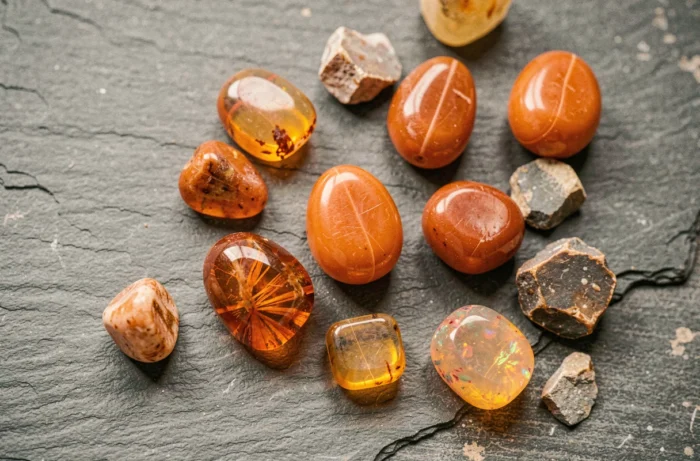
When looking for an orange stone for jewelry or for use in lithotherapy, the first instinct is often to turn to carnelian. It’s a solid choice, but the spectrum of orange stones goes far beyond this single variety. Understanding what distinguishes a spessartite garnet from a fire opal or a simple orange calcite radically changes the way one chooses, wears, and maintains these gems.
Orange spessartite garnet: the gem on the rise in the market
The spessartite garnet, sometimes called “mandarin garnet” in its purest variety, is establishing itself as a reference among orange stones in jewelry. Recent trade shows confirm a growing interest in this gem, driven by a global demand for orange hues.
The mandarin variety, with a pure orange without brown or red tones, commands a significant price premium. We’re talking about a price that can sometimes be more than double that of other shades of comparable spessartite. This is no small detail: for those considering a purchase, the exact shade of the stone makes all the difference to the budget.
The availability of larger sizes is notably decreasing. If you want a piece over a carat in a bright, clean orange, it’s best not to wait too long. To delve deeper into the symbolism and origins of these gems, you can read the article on binnews.info that details these aspects.
This repositioning of spessartite illustrates a broader movement. Orange is no longer confined to lithotherapy or mineral collections. Orange stones are becoming sought-after alternatives in mid-range jewelry, as prices for classic gems (rubies, blue sapphires) continue to rise.
Carnelian, fire opal, calcite: choosing your orange stone according to use
Not all orange stones are created equal in terms of hardness, durability, and maintenance. Before falling for a color, it’s important to check the intended use.
Orange stones for everyday jewelry
Carnelian remains the most versatile choice. Its hardness on the Mohs scale makes it suitable for rings and bracelets worn daily. Tiger’s eye, with its shimmering reflections leaning towards brown-orange, offers comparable durability.
The spessartite garnet, softer than sapphire but hard enough for jewelry, is well-suited for pendants and earrings. For rings, a protective setting is preferred.
Fragile or collectible orange stones
Fire opal is beautiful but requires precautions. It is sensitive to thermal shock and dehydration. It’s best to avoid wearing it in the shower or under prolonged direct sunlight. Orange calcite, even softer, is more suited for decorative objects or lithotherapy sessions than for jewelry.
- For everyday jewelry use: carnelian, tiger’s eye, spessartite garnet (in a closed setting for rings)
- For occasional jewelry or pendants: fire opal, sunstone, imperial topaz
- For collection, meditation, or decoration: orange calcite, aragonite, orange aventurine
Feedback varies on sunstone: some varieties are durable enough for a bracelet, while others scratch easily. Asking the seller for the exact provenance helps make a decision.
Symbolism of the orange color in lithotherapy and gemology
In lithotherapy, orange stones are traditionally associated with the second chakra, the sacral chakra, located below the navel. They are believed to influence creativity, vitality, and emotional energy.
Carnelian is the most commonly used orange stone for this chakra. Practitioners recommend it to stimulate self-confidence and remove blocks related to personal expression. Orange aragonite and orange calcite are also frequently cited for centering and grounding uses.
In gemology, the orange color in a stone results from the presence of specific chemical elements. Manganese colors spessartite, iron gives its hue to carnelian, and internal light play creates the reflections of sunstone. The pure orange shade, without turning towards brown or red, is the most sought after regardless of the mineral.
Concrete criteria for buying an orange stone without error
You don’t choose an orange stone like you choose a piece of clothing. A few checks can avoid unpleasant surprises.
- Check if the stone has undergone thermal treatment: carnelian is often heated to enhance its color, which is a common and accepted practice, but must be mentioned by the seller
- Ask about the geographic origin: a spessartite from Nigeria does not have the same profile as a spessartite from Mozambique in terms of shade and inclusions
- Observe the stone in natural light: shop lighting flatters all gems, but it’s outside that you see the true color
- Compare price to weight: for mandarin spessartite, the price per carat increases significantly with the size of the stone
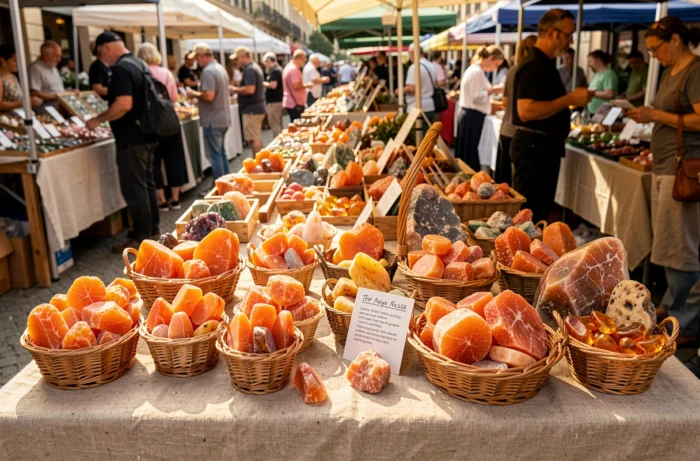
For online purchases, demanding unretouched photos and a gemological certificate for any stone above a certain budget remains the best protection. Orange stones also attract imitations in glass or resin, especially for carnelian and fire opal.
The market for orange-colored stones is experiencing a resurgence of interest that industry professionals attribute to a diversification of tastes in jewelry. Orange gems are no longer curiosities at trade shows, but integral pieces in contemporary collections. Whether one is looking for a stone for its symbolic virtues or to create a unique piece of jewelry, the quality of the shade and the transparency of the seller remain the two criteria that truly matter.