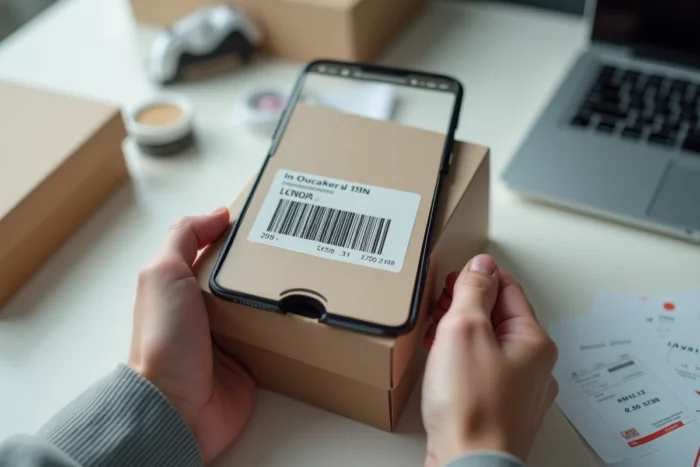
A successfully scanned Nike UPC code does not guarantee that the pair in front of you is authentic. This barcode, consisting of twelve digits, identifies a product in a commercial database. Counterfeiters know this, and many reprint a legitimate UPC on boxes and labels of copies. The question is not whether the code is valid, but whether all the markers of the shoe match the product that this code designates.
Limitations of the Nike UPC Code Against Recent Counterfeits
The most common reflex is to scan the barcode with a UPC reading app, then check that the displayed product matches the purchased model. This check filters out gross counterfeits, those whose code links to a completely different product or does not appear in any database.
The problem arises with well-made copies. A real UPC can appear on a fake pair, since nothing prevents copying a public sequence of numbers. Several recent authentication guides highlight this limitation, often underestimated by buyers who stop at the scan.
Before delving into cross-checking methods, it is still useful to know how to verify the authentic Nike UPC code by comparing it to the serial number on the inner label of the shoe. This first check already eliminates a significant portion of low-quality copies.
On the other hand, for high-end replicas, scanning alone gives a false sense of security. It is the consistency between several elements that allows for a decisive judgment.
Cross-Referencing the UPC Code and Nike SKU: A Reliable Verification Method
The SKU (Stock Keeping Unit) is Nike’s product code, usually in the format XX-YYYY (letters and numbers). It appears on both the label attached inside the shoe and on the side of the box. The UPC, on the other hand, appears under the barcode on the box and sometimes on the inner label.
These two codes must designate exactly the same model, colorway, and size. Any discrepancy indicates either a packaging error (rare at Nike in official channels) or a counterfeit.
| Checked Element | Authentic Pair | Common Counterfeit |
|---|---|---|
| UPC box vs inner label | Identical | Often identical (copied) |
| SKU box vs inner label | Identical | Sometimes different or absent |
| SKU vs Nike.com product sheet | Model and colorway match | Incorrect model or colorway |
| Size indicated (label vs box) | US/UK/EU/CM match | Frequent conversion errors |
| Font and spacing on label | Clear, consistent, aligned | Blurry, irregular spacing |
This table summarizes the cross-checking points. The middle column describes the expected behavior for a legitimate pair. The right column shows where copies most often fail.
Verification via the GEPIR Database
The GEPIR (Global Electronic Party Information Registry) database allows tracing from the barcode to the brand owner. By entering the first digits of the UPC, the registered company is identified. For Nike, the manufacturer prefix must correspond to Nike Inc. An unknown prefix or one assigned to another company is a direct warning signal.
GEPIR confirms the owner of the code, not the authenticity of the pair. It is an additional filter, not definitive proof.
Physical Inspection of the Nike Inner Label
The inner label remains the most revealing checkpoint because it concentrates several verifiable pieces of information and is difficult to reproduce perfectly.
- The Nike font uses a specific style, with consistent spacing between the digits of the code. On counterfeits, the characters are often thicker, thinner, or irregularly spaced.
- The alignment of lines (size, country of manufacture, SKU, UPC) follows a strict template. A vertical or horizontal shift between lines betrays a non-compliant print.
- The country of manufacture mentioned on the label must correspond to the known factories for the model in question. Nike produces in several countries, but a given model typically comes from a limited number of sites.
- The quality of the print itself matters: an authentic label features sharp characters without smudging, while copies sometimes show slight blurriness or irregular edges on the letters.
The inner label concentrates more clues than the box, because it requires meticulous reproduction that many counterfeiters neglect.
Assembled Pairs and Multi-Criteria Authentication Tools
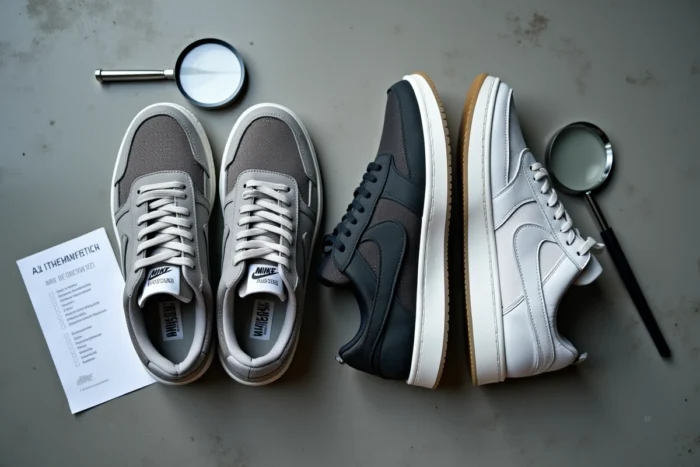
A scenario rarely addressed in classic guides concerns so-called “assembled” pairs. Authentic components (sole, upper, label) from different batches or factory rejects are combined to form a pair that passes each individual code test but has never existed as a finished product validated by Nike.
This type of fraud escapes UPC scanning, SKU cross-referencing, and even basic visual inspection. Only a comprehensive consistency analysis detects assembled pairs: matching the actual colorway with the referenced one, glue quality, symmetry between the left and right foot.
Verification Applications and Services
Several applications now combine barcode scanning, photographic comparison, and automated analysis to provide an authenticity opinion. These tools do not replace a complete physical examination but add a useful layer of control when purchasing remotely, such as on a resale platform.
Nike is also gradually integrating NFC chips into some recent models, offering an additional verification channel directly linked to the manufacturer’s database. This technology is not yet widespread across the entire range.
The UPC code remains a valid entry point for filtering out the most obvious counterfeits. Its true utility appears when it is cross-referenced with the SKU, the official product sheet, and the physical inspection of the label. No isolated criterion is sufficient to authenticate a Nike pair: it is the overall consistency that makes the difference between a superficial check and a truly reliable control.