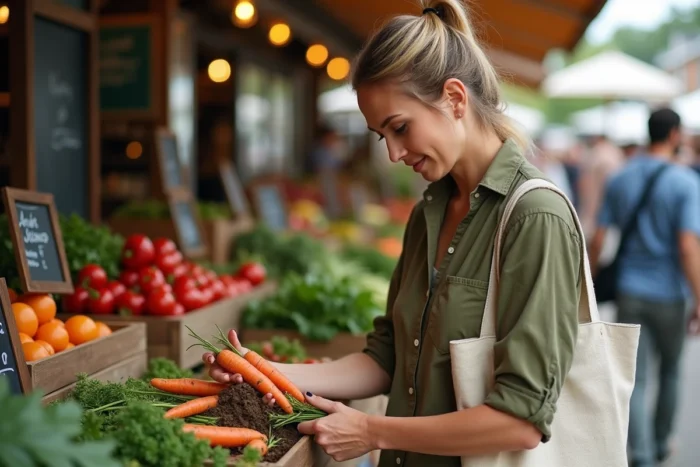
Finding local organic products near you requires understanding what these two words mean together. “Organic” refers to a certification governed by a European specification. “Local” has no official definition: depending on the initiatives, the radius of origin can vary from a few kilometers to several hundred. This lack of framework opens the door to labeling practices that deserve careful examination even before discussing purchasing circuits.
Check if a local organic product is truly organic and truly local
The Organic Farming certification relies on an annual inspection by an accredited organization. A producer selling at an open-air market must be able to present their up-to-date certificate. The directory of the Agence Bio allows you to verify if a farm is indeed certified, along with its operator number.
For the local dimension, no regulatory label exists. A farmer located twenty kilometers away and a wholesaler redistributing organic products from the other end of the country can both claim to be “local” without breaking the law. The absence of an official definition of “local” allows for unverifiable claims.
Some reflexes can help dispel doubt. Asking for the exact place of production (municipality, department) and checking the consistency with the season is a first filter. A display of local organic strawberries in January in Normandy raises questions.
Cross-referencing information with public tools like the Frais et Local platform, promoted by the Ministry of Agriculture with the Chambers of Agriculture, offers an additional point of control. This mapping geolocates direct sales points around your location, with data sourced from territorial agricultural networks.
An online directory like https://www.lebioducoin.fr/ also aggregates organic producers by geographic area, making it easier to cross-check what a seller displays and what professional databases confirm.
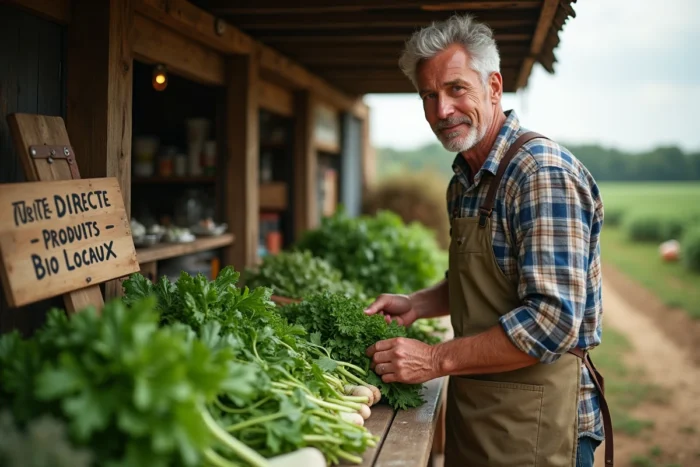
Public tools and private platforms: different levels of reliability to find organic producers
The Frais et Local platform, supported by the Chambers of Agriculture since 2021, functions as an institutional directory for direct sales. It lists farms by type of production and location. Its advantage lies in the source of the data: it is the departmental agricultural structures that feed the database.
Private platforms like Bon Plan Bio, which claims over 3,000 sales points in Occitanie, Nouvelle-Aquitaine, Brittany, Grand Est, and Normandy, offer a complementary service with online ordering and producer relays. Public tools verify the status of the farm, while private platforms facilitate purchasing. The two do not serve the same function.
Field feedback varies on the updating of these directories. A producer who ceases operations or loses certification may remain listed for several months. Cross-referencing at least two sources (one institutional tool and one private directory) reduces the risk of outdated information.
What the maps do not show
No platform indicates the actual share of local production in the offerings of a sales point. A certified organic farm can resell products purchased from wholesalers to complete its range, without this being reflected in the directories. The short circuit does not automatically guarantee local production: the official definition of a short circuit pertains to the number of intermediaries (a maximum), not the distance.
Imported organic and local organic: how the strengthening of European controls changes things
The European Union strengthened the regulation of the organic logo for imported products in 2026, requiring equivalent standards and additional controls. This regulatory evolution widens the gap between a certified local organic product, controlled by a French organization, and an imported product whose certification relies on sometimes less stringent references.
For the consumer, the practical consequence is simple: an organic product bearing the European logo and mentioning “Agriculture France” offers a higher level of traceability than an imported organic product, even if certified. The mention of origin, often in small print on the packaging, remains the first reliable indicator.
In direct sales, the question arises differently. A producer selling their own vegetables at the farm or at a market reduces the chain to zero intermediaries. Traceability is immediate. It is in specialized stores and delivered baskets that vigilance regarding the actual geographical origin of the products requires more attention.
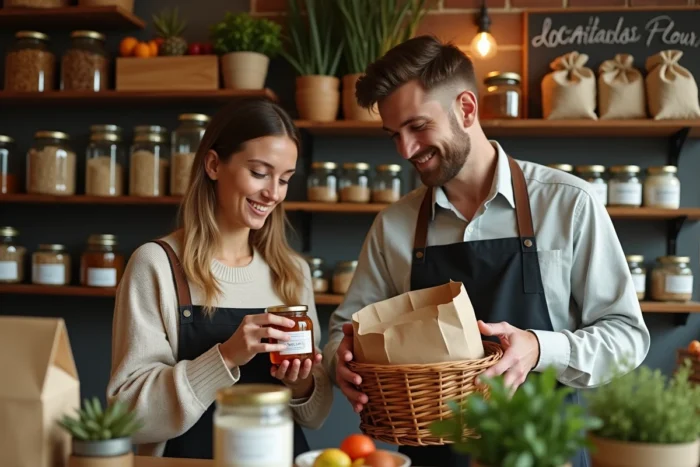
Open-air markets, farms, and baskets: comparing channels for local organic purchases
Not all channels are equal in terms of transparency and actual proximity to the producer. Here are the main distinguishing criteria:
- Dedicated organic markets bring together producers who sell their own harvest, but some so-called “organic” markets also host resellers. Asking whether the seller is a producer or a trader clarifies the situation.
- Farm sales eliminate all intermediaries and allow you to see the production conditions. It is the most transparent channel, but it requires traveling and adapting to the producer’s schedule.
- Weekly baskets (AMAP, producer relays) offer a regular commitment. The contents of the basket vary by season, reflecting the reality of local production. A basket that remains too constant from week to week may indicate supplementation through external purchases.
- Online ordering platforms with pickup at relays combine convenience and access to multiple producers, but verifying the origin remains the consumer’s responsibility.
The choice depends on the available time and the desired level of verification. A purchase at the farm provides total visibility. A delivered basket requires trusting the network organizer.
Reducing packaging and organic waste: a context pushing towards local
As of January 1, 2024, all individuals must have a source separation solution for their organic waste. This obligation modifies food purchasing habits. Buying in bulk and using reusable containers is easier to practice in short circuits than in large retail.
Local organic producers who sell directly often offer a deposit system or accept containers brought by the customer. This practice reduces packaging waste production, an additional argument but one that does not replace the verification of certification and geographical origin.
Searching for local organic products remains a process that requires a minimum of investigation. Tools exist, both public and private, but none eliminate the need to ask the right questions to the seller. The mention “local organic” on a display or website has value only if it is based on verifiable certification and a precise geographical origin.