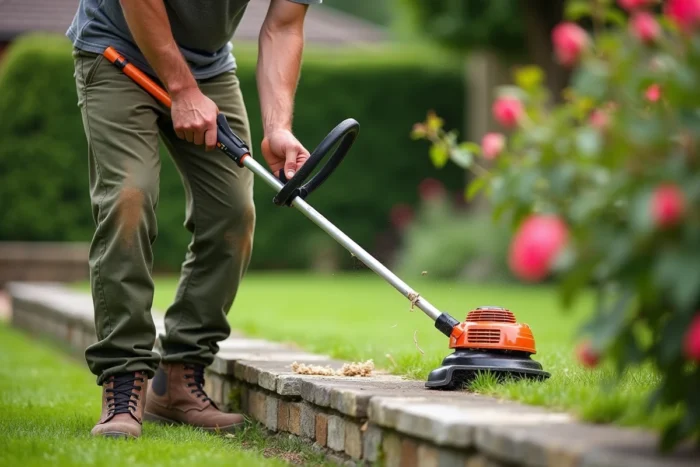
When mowing a lawn with flower beds, fruit trees, or a stone wall, there is always a fringe of untouched grass at the base of the obstacles. This is precisely where the string trimmer comes into play. Understanding its cutting mechanism and limitations helps avoid breaking string unnecessarily, damaging the bark of young trees, or working at inappropriate times during dry periods.
Nylon String and Centrifugal Force: The Mechanical Principle of the String Trimmer
The string trimmer does not cut like a blade. A motor (electric, gas, or battery-powered) drives a spool housed in the cutting head. This spool releases a nylon string that, spun at very high rotational speed, cuts the grass solely by centrifugal force. The string becomes rigid due to the speed, just like a taut whip.
The thickness of the string determines the type of vegetation that can be tackled. A thin string is suitable for finishing a short lawn. A thicker string can better handle dense or semi-woody grasses. The protective guard, this half-circle of plastic above the head, limits debris projection and protects nearby plants.
To understand how a string trimmer works, it can be summarized into three components: a motor, a spool of nylon string, and a guard. Everything else (telescopic handle, auxiliary handle, harness) relates to ergonomics, not the cutting mechanism.
Prefectural Orders and Usage Windows for String Trimmers in Summer

Classic user guides rarely mention seasonal regulations. Since summer 2026, several French departments have issued prefectural orders that limit the use of motorized tools (including string trimmers) during the hottest hours due to fire risk.
In Vienne, for example, the use of any motorized tool is prohibited from 2 PM to 8 PM during periods of high risk, effective from June 19, 2026. Similar measures exist near forested areas: as soon as the fire vigilance level reaches “severe” (orange), the prohibition runs from 1 PM to midnight. At the “very severe” (red) level, use is strictly prohibited at any time.
People rarely think to check local orders before taking out the string trimmer on a Sunday afternoon in July. On the outskirts of fields, on a dry slope, or at the edge of woods, a simple nylon string spinning at full speed can generate a spark upon contact with a stone. Consulting the website of the prefecture or municipality before each summer cutting session becomes a habit to adopt.
Cutting Technique with the String Trimmer: Concrete Actions for a Clean Result
The basic movement is a horizontal sweep, from left to right for a right-handed person, keeping the cutting head slightly tilted. Move slowly, allowing the string to do the work. Forcing the device into the vegetation does not cut better: it breaks the string and overloads the motor.
Flower Bed Edges and Tree Bases
At the base of a young tree, the temptation is to get as close as possible for a clean finish. The problem: the nylon string can gouge the bark and compromise sap circulation. Protective sleeves are available to encircle the trunk, but the simplest action remains to maintain a distance of at least a hand’s width between the string and the bark.
Along a flower bed, turn the device so that the guard protects the plants. The string projects debris in the opposite direction to the guard, allowing control over where the debris goes.
Tall Grasses and Overgrown Areas
On a plot left unattended for several weeks, a low-powered string trimmer will struggle. The approach is then to proceed in two passes: a first high pass to flatten the vegetation, followed by a second close to the ground. Feedback on this point varies depending on the motor’s power and the string’s diameter, but this two-step approach spares the mechanics in most cases.
String Trimmer Maintenance: String, Spool, and Motor
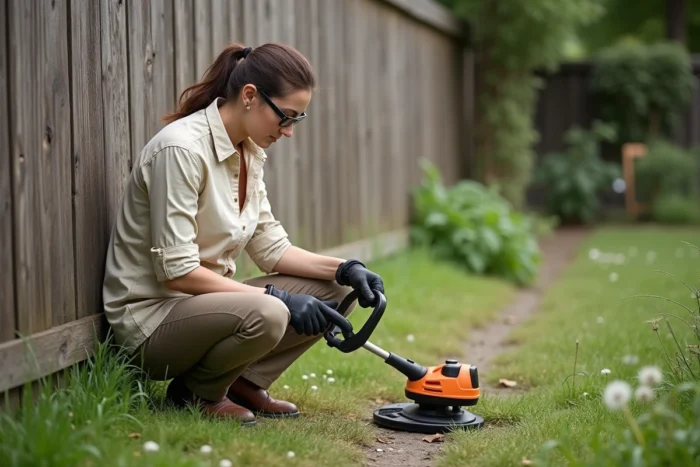
A poorly maintained string trimmer consumes more string, cuts less effectively, and tires the user. A few regular checks are enough to keep the device in good condition.
- Spool and nylon string: rewinding the string without overlapping prevents jams. A string stored dry remains flexible longer. A dried-out string breaks at the first obstacle.
- Protective guard: check that it is securely attached before each use. A cracked guard no longer retains flying debris.
- Air filter (gas models): a clogged filter reduces engine power and increases consumption. Clean or replace it at the beginning of the season.
- Battery (cordless models): store the battery between 40% and 80% charge when not using the device for several weeks. Avoid leaving a battery empty all winter.
Gas, Electric Corded, or Battery String Trimmer: Choose According to the Terrain
The choice of power type depends less on budget than on the garden’s configuration.
- The corded electric string trimmer is suitable for small gardens near an outlet. Lightweight, quiet, and requiring no engine maintenance, but limited by the length of the extension cord.
- The battery model offers the same freedom of movement as a gas model, without the mixing or draining hassles. Battery life remains the weak point: on a large property, a second battery may be needed.
- The gas string trimmer remains the most powerful for large areas or tough grasses. In return, it is heavier, noisier, and subject to the summer restrictions mentioned above.
A city garden with a few lawn edges does not need the same machine as a rural property bordered by slopes. Adapting the tool to the terrain, and not the other way around, avoids both unnecessary expense and the frustration of an undersized device.