
Which printable calendar format is best suited for a person with Alzheimer’s disease, and what concrete criteria should this choice be based on? Between font size, the amount of information displayed per day, and the type of visual cues, there are many variables. This article compares the formats available for free online and details the design principles that make a difference in daily life.
Wall, weekly, or daily calendar: a comparison of printable formats
Websites offering free downloadable calendars provide several variations. Not all meet the same needs depending on the stage of memory impairment.
| Format | Display | Readability | Suitable for moderate to severe impairments |
|---|---|---|---|
| Monthly (one page) | 30-31 days visible | Small boxes, dense text | Poorly suited: information overload |
| Weekly (double page) | 7 days visible | Medium boxes, daily cues | Fair for a moderate stage |
| Daily (one sheet per day) | 1 single day visible | Large font, little text | Most suitable for advanced stages |
| Minimalist (clean monthly) | 30-31 days, no details | Good if font is large enough | Useful for date tracking only |
A calendar for elderly people with Alzheimer’s in daily format remains the safest choice when temporal disorientation is present. The principle is simple: one sheet visible per day reduces confusion.
Monthly calendars on one page, available on sites like calendrier-telecharger.com or calendarforge.net, are more suitable for caregivers planning the week. For the individual, they pose a problem of visual overload that the daily format eliminates.

Minimalism of reminders on a printable Alzheimer’s calendar
Filling each box of a paper calendar with all appointments, home care schedules, and medication reminders seems logical. Support professionals recommend the opposite approach.
Limiting reminders to three or four major cues per day (wake up, main meal, visit, bedtime) decreases the risk of agitation. An overloaded calendar can cause anxiety in a person who can no longer prioritize the displayed information.
This principle of simplicity, documented by SeniorCybernet in an article published in August 2026, applies to both digital media and printed paper calendars created at home. Specifically, this means that when annotating the printed calendar, the caregiver should:
- Only write down activities that require action from the person (not tasks managed solely by the caregiver)
- Use simple pictograms (sun for morning, moon for evening) instead of long text
- Deliberately leave blank spaces to avoid the “wall of text” effect on the sheet
On the other hand, fixed elements like the day of the week and the date in large characters should always be present. Temporal tracking takes precedence over the content of activities.
Display and readability: technical criteria for a calendar suitable for cognitive impairments
Printing a free calendar from a browser does not guarantee a readable result for a person whose visual and cognitive abilities are impaired. Several technical parameters make the difference between a useful support and one that is ignored.
Font size and contrast
The day and date must occupy at least one third of the sheet’s surface. On an A4 format, this corresponds to a font of at least 72 points for the day of the week and at least 96 points for the date number. Most free online calendars use much smaller fonts, designed for standard office use.
Black on a white background remains the most readable. Colored backgrounds or decorative illustrations, common on family calendars, reduce readability for a person with cognitive impairments.
Analog or digital date orientation
Writing “Tuesday, January 14” in full helps more than a simple “14/01” in numbers. Displaying the day and month in full supports temporal tracking even when the person no longer understands the abbreviated numerical notation.
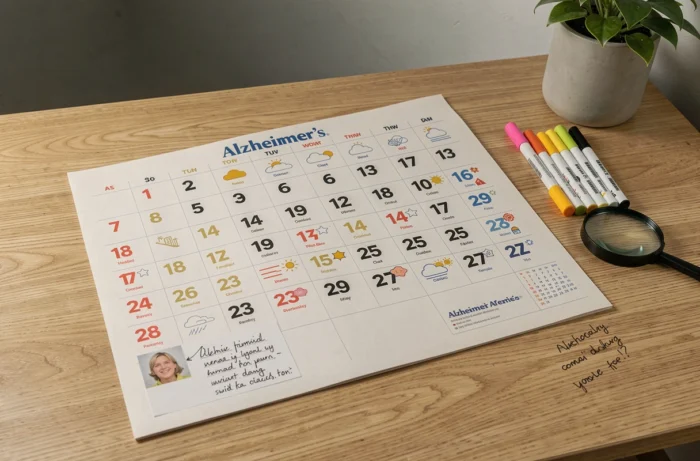
Paper calendar and technical aid: what it changes for families
A point rarely addressed by product websites concerns the regulatory status of these supports. Calendars, whether paper or electronic, are classified as technical aids and not as medical devices. This distinction has direct consequences.
- No medical prescription is required to obtain or use a suitable calendar
- Commercially sold electronic calendars are not reimbursed by health insurance as medical devices
- Families can design and print their own support without regulatory constraints, adapting the format to the specific needs of their loved one
This freedom of design is a concrete advantage of the free printable calendar compared to commercial digital solutions. The caregiver adjusts the content, size, visual cues, and can modify the support from week to week based on the individual’s evolving capabilities.
For stages where memory impairments and disorientation are advanced, a printed daily calendar placed in the same spot every morning provides a simple anchor. The paper support, unlike a screen, requires no manipulation and remains visible at all times. It is often this consistency, more than the sophistication of the format, that preserves temporal orientation for as long as possible.